




Learn how to calculate pond surface area using simple formulas and practical examples. Discover how to measure round ponds, convert square feet into acres, estimate water volume, and use map-based tools for accurate area estimates.
A garden pond may look small from the ground, but its actual surface area can be difficult to estimate. Knowing how to calculate pond surface area helps you understand how much space the water covers, whether you're maintaining a backyard pond, planning a fish pond, or measuring a larger farm pond.
For a round pond, the calculation is straightforward once you know its radius or diameter. You can express the result in square feet, square meters, or acres, depending on the pond's size. This guide explains the measurements, formulas, conversions, and mapping methods you can use to estimate pond area accurately.
How to Calculate Pond Surface Area
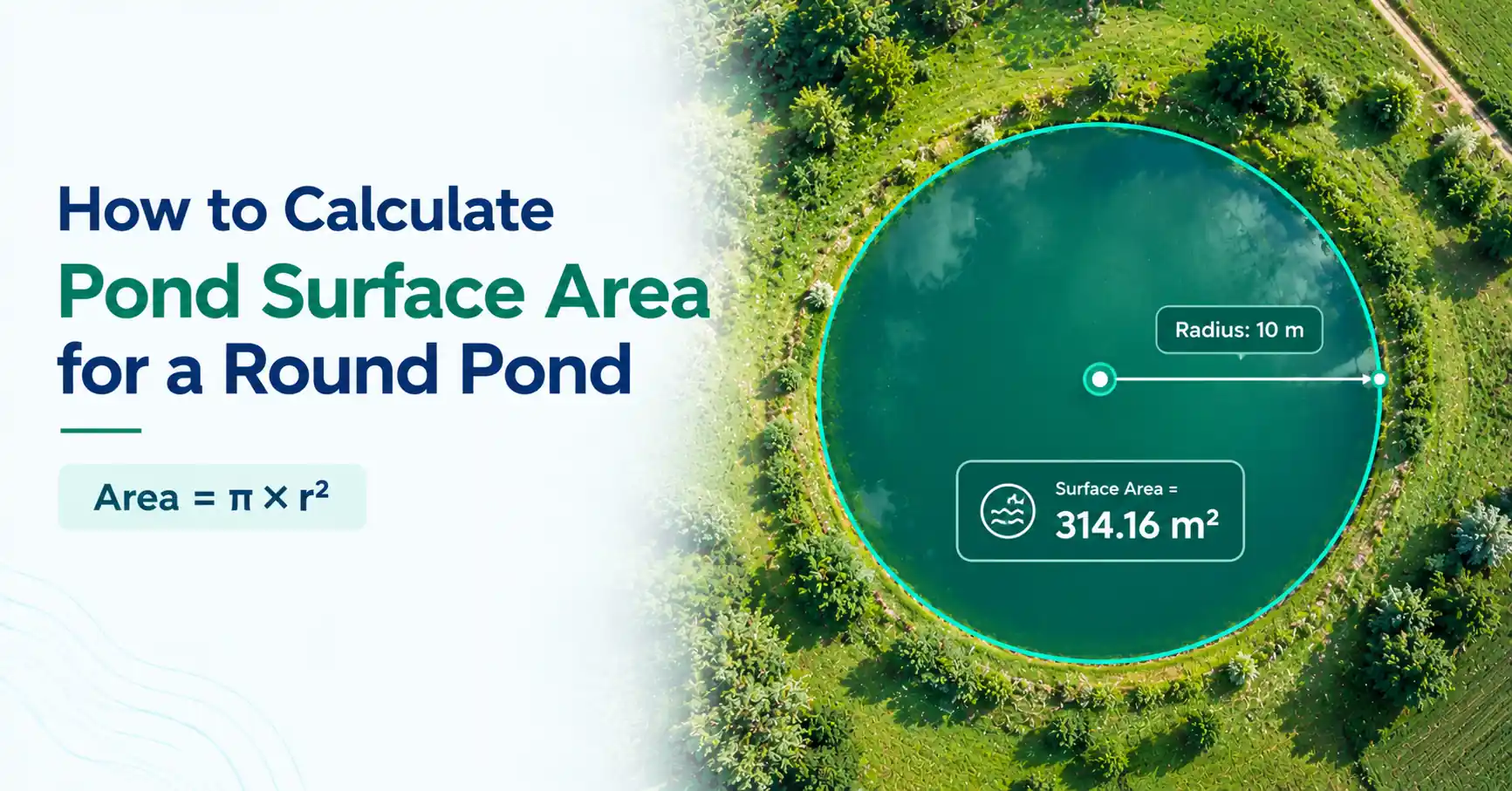
To calculate the surface area of a round pond, measure its radius and use the circular area formula, Area = π × radius². If you know the diameter, divide it by two to find the radius. For example, a pond with a radius of 10 feet covers approximately 314.16 square feet.
This measurement describes the water's surface when viewed from above. It does not tell you how much water the pond contains, because water volume also depends on depth.
What Is Pond Surface Area?
Pond surface area is the horizontal space covered by water within the shoreline. It is usually measured in square feet or square meters, while larger ponds may be measured in acres or hectares.
For example, two ponds with the same surface area can hold different amounts of water if one is deeper.
The water level also affects the measured area. A pond with gently sloping banks may cover more ground after heavy rainfall than during a dry period.
Surface area measurements are useful for pond planning, maintenance, and comparing the sizes of water features.
How to Measure a Round Pond
The easiest way to measure a nearly circular pond is to find its diameter, which is the distance across the center from one edge to the opposite edge.
The radius is half that distance.
If you're learning how to measure a round pond, follow these steps:
Identify the pond's visible waterline.
Estimate where the center of the circle would be.
Measure the diameter across the pond through its center.
Divide the diameter by two to find the radius.
Use the radius to calculate the surface area.
For a small garden pond, a measuring tape may work if both edges are safely accessible. Larger ponds may be easier to measure using aerial maps or existing plans.
If the pond looks slightly oval, measure across it in two directions to check whether a circular calculation is suitable.
Round Pond Area Formula: Radius, Diameter, and Circumference
The standard round pond area formula uses the radius, but you can also calculate area from the diameter or circumference.
The three relationships are:
Radius: Area = π × r²
Diameter: Area = π × (d ÷ 2)²
Circumference: Area = C² ÷ (4π)
Here, π is approximately 3.14159.
The circumference is the distance around the pond's shoreline. If a pond is truly circular, all three methods produce the same area when the measurements are correct.
The diameter method is useful when you can measure across the pond. The circumference method may help when measuring around the shoreline is more practical.
These formulas work for circular shapes, but irregular shorelines need a different approach.
How to Calculate Pond Area in Square Feet
Calculating pond area in square feet is straightforward when the radius is measured in feet.
Suppose a circular pond has a diameter of 20 feet. Its radius is 10 feet, giving a surface area of approximately 314.16 square feet.
A useful detail about circles is that doubling the diameter increases the surface area four times.
For example, a pond with a 40-foot diameter covers about 1,256.64 square feet, even though its diameter is only twice that of the smaller pond.
This relationship helps explain why a modest increase in pond width can produce a much larger water surface.
How to Calculate Pond Area in Square Meters
The same circular formula works with metric measurements.
A pond with a radius of 5 meters has a surface area of approximately 78.54 square meters.
This result describes the water surface rather than its capacity.
One square meter equals approximately 10.764 square feet, so you can convert between these units when comparing measurements.
For a reliable circular pond area calculation, keep all dimensions in the same unit before finding the area.
How to Calculate Pond Area in Acres
Larger farm ponds are often measured in acres instead of square feet.
One acre contains 43,560 square feet. To convert pond surface area into acres, divide its square footage by 43,560.
For example, a circular pond with a radius of 100 feet covers approximately 31,416 square feet, or about 0.72 acres.
This is the standard approach for anyone learning how to calculate pond area in acres.
If your measurements are in square meters, you can divide the area by approximately 4,046.86 to obtain acres.
Round Pond Surface Area Examples
The following table shows how a round pond's surface area changes with its diameter.
Pond Diameter | Surface Area | Approximate Acres |
| 10 ft | 78.54 sq ft | 0.0018 |
| 20 ft | 314.16 sq ft | 0.0072 |
| 40 ft | 1,256.64 sq ft | 0.0289 |
| 60 ft | 2,827.43 sq ft | 0.0649 |
| 100 ft | 7,853.98 sq ft | 0.1803 |
These figures assume perfectly circular ponds.
The table also shows that surface area increases much faster than diameter. A pond twice as wide covers four times the surface area.
How to Measure Pond Area on a Map
Digital mapping tools are useful when a pond is too large to measure easily from the ground.
If you want to know how to measure pond area on a map, start with a clear aerial or satellite view of the water.
A typical process involves:
Open a map-area measurement tool.
Find the pond using its location or address.
Zoom in until the shoreline is visible.
Place measurement points around the water's edge.
Connect the points to create a closed boundary.
Review the calculated area in your preferred unit.
Remember that satellite images may have been captured at a different water level. The result may therefore differ from the pond's current surface area.
Google Maps' basic Measure Distance feature measures lengths, not enclosed areas directly.
Using a Pond Surface Area Calculator
A pond surface area calculator can save time when you already know the pond's dimensions.
For a circular pond, most basic calculators need a radius or diameter and the preferred measurement unit.
A map-based calculator works differently. Instead of assuming a perfect circle, it estimates the enclosed area from points placed around the visible shoreline.
The best method depends on the pond's shape and the measurements available.
For a small, round garden pond, the circular formula is usually enough. For an irregular farm pond, tracing its outline on a map may give a more useful estimate.
Surface Area vs Water Volume: What's the Difference?
Surface area and water volume describe different characteristics of a pond.
Surface area measures the space covered by the water when viewed from above. Volume measures the amount of water contained inside the pond.
To estimate volume, you need both the surface area and the average water depth.
A basic approximation is Volume ≈ Surface Area × Average Depth.
For natural ponds, this is an estimate because the bottom may slope or contain deeper sections.
Maximum depth should not automatically replace average depth. Doing so can greatly overestimate the amount of water.
How to Calculate Water in a Round Pond or Pool
A round pool with straight vertical sides and a flat bottom can be treated as a cylinder.
For example, a circular pool with a radius of 2 meters and a uniform water depth of 1 meter holds approximately 12.57 cubic meters of water.
Since one cubic meter equals 1,000 liters, that is about 12,570 liters.
Natural ponds are different because their depth is rarely uniform. Two ponds with identical surface diameters may contain very different water volumes.
For an irregular pond, measuring depth at several locations can help estimate an average, but the result remains approximate.
How Big Is a 4,000-Liter Pond?
A 4,000-liter pond contains 4 cubic meters of water, but its surface area depends on its depth and shape.
For example, imagine a circular pond with vertical sides and a uniform depth of 1 meter. Holding 4,000 liters would require a water surface of 4 square meters and a diameter of approximately 2.26 meters.
A pond that is only half as deep would need twice the surface area to hold the same volume.
That is why liters alone cannot tell you how wide a pond is.
What If the Pond Is Not Perfectly Round?
Many garden and farm ponds have uneven shorelines. If the pond is slightly oval, an ellipse may provide a better estimate than a circle.
For an approximately elliptical pond, multiply π by half the longest diameter and half the shortest diameter.
This works best when the pond closely resembles an oval.
For highly irregular ponds, measure the visible shoreline using connected points on a map or divide the shape into simpler sections.
A circular estimate can be too high or too low when the pond's shape differs significantly from a circle.
Common Mistakes When Measuring Pond Surface Area
One common mistake is using the diameter where the formula requires the radius. Since the radius is half the diameter, confusing them can produce a much larger result.
Another problem is mixing meters and feet without converting them first.
Pond owners may also measure the outer bank instead of the current waterline, which changes the enclosed area.
When estimating volume, using maximum depth instead of average depth can produce misleading results.
Finally, remember that a pond's water surface may change with rainfall and seasonal conditions. A measurement taken from an old satellite image may not represent today's shoreline.
Final Thoughts
Knowing how to calculate pond surface area makes it easier to understand the size of a garden pond, fish pond, or larger water feature.
For a round pond, the circle area formula uses the radius to calculate the water surface. Results can be expressed in square feet, square meters, or acres.
If the shoreline is irregular, a map-based measurement may be more useful. To estimate water capacity, you also need depth information because surface area alone cannot determine volume.
Frequently Asked Questions
Measure the radius and multiply π by the radius squared. If you only know the diameter, divide it by two first. The result is the pond's horizontal surface area in square units.
The formula is A = πr², where A represents area and r represents radius. If the radius is measured in feet, the result is square feet. If measured in meters, the result is square meters.
You can estimate the area using a digital map tool. Find the pond, mark points around the visible shoreline, and close the boundary. The tool can then estimate the enclosed water surface.
First calculate the pond's surface area in square feet. Divide that result by 43,560 to convert it into acres. A pond covering 21,780 square feet has a surface area of half an acre.
Water capacity depends on surface area and average depth. Multiplying these measurements provides a rough volume estimate when units are consistent. Natural ponds may require additional depth measurements because their bottoms are rarely uniform.
A 4,000-liter pond holds 4 cubic meters of water. Its diameter and surface area depend on its depth and shape. A shallow pond needs a larger surface area than a deeper pond with the same capacity.