



Learn how to find the area of a circle with A = πr². Easy steps, worked examples, circumference formulas and a free circle calculator.
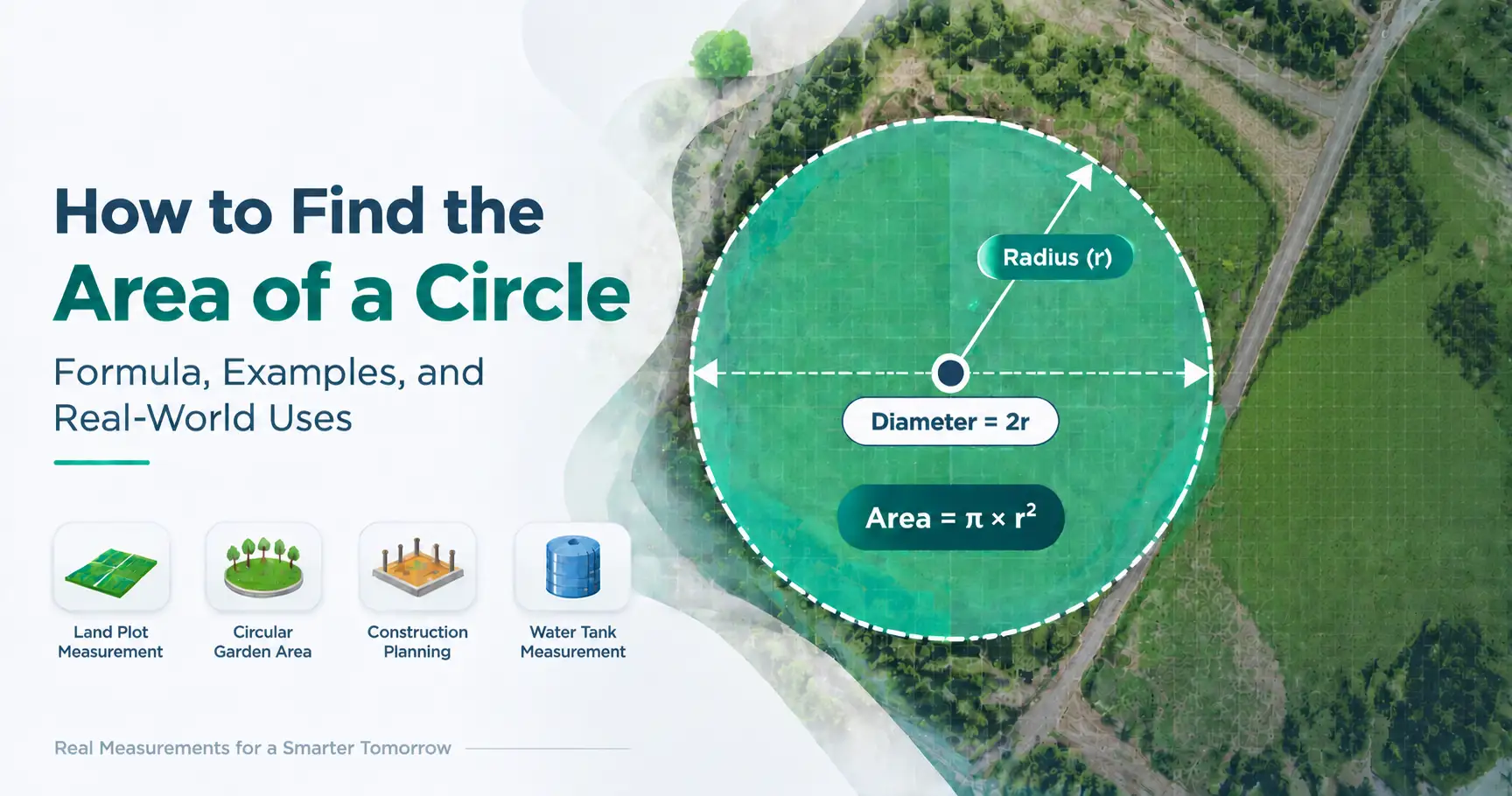
The area of a circle is the space inside its edge. You find it with the formula A = πr², where r is the radius and π (pi) is about 3.14. Need the answer now? Use our free circle area calculator to draw a circle on a map and see its area instantly.
If you're wondering how to find area of a circle by hand, it takes three quick steps. This guide shows you how to find the area of a circle, how to find circumference, and how to get the diameter from the radius. You'll also see how farmers use these formulas on real land.
Quick Answer
Here are the three circle formulas you'll use most:
• Area: A = πr²
• Circumference (perimeter): C = 2πr or C = πd
• Diameter from radius: d = 2r
What Are the Radius, Diameter and Circumference?
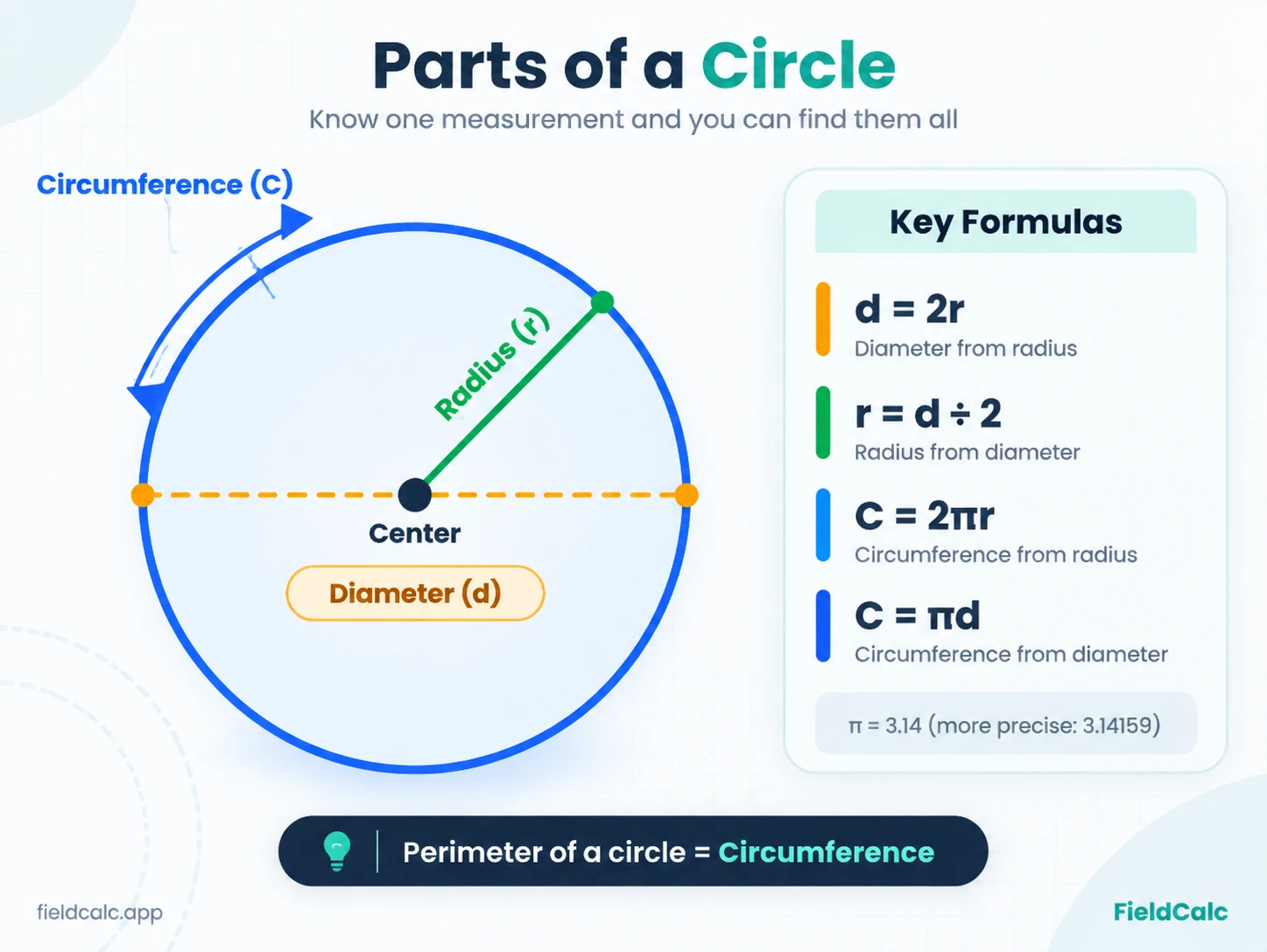
The radius, diameter and circumference are the three main measurements of a circle. If you know one, you can find the others and the area.
• Radius (r): the distance from the center to the edge.
• Diameter (d): the distance straight across, through the center. It's twice the radius.
• Circumference (C): the distance around the edge. The perimeter of a circle is called its circumference.
What is the radius and diameter of the following circle? Look at the following circle: its edge is 14 cm from the center. So the radius is 14 cm, and the diameter is 14 × 2 = 28 cm.
How Do You Find Diameter From Radius?
To find the diameter from the radius, multiply the radius by 2. To find the radius from the diameter, divide by 2.
d = 2r
r = d ÷ 2
A round table with a 45 cm radius has a diameter of 90 cm. A water tank 3 m across has a radius of 1.5 m. Always check which one you have. Many people measure straight across because it's easier, then forget to halve it before finding the area.
How to Find the Area of a Circle (Step by Step)
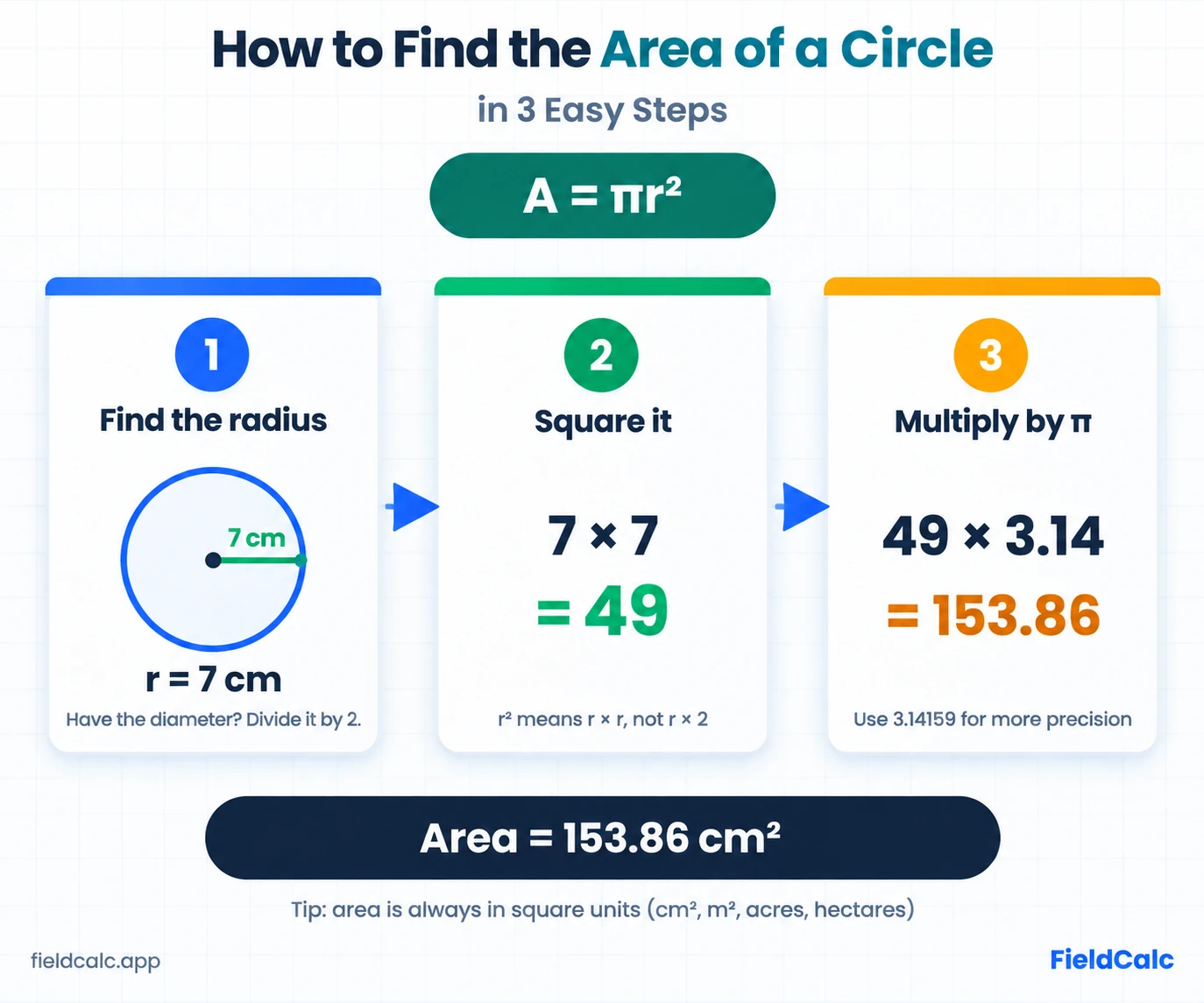
To find the area of a circle, square the radius and multiply by π. Area is always in square units, such as cm², m² or acres.
A = πr²
1. Find the radius. If you have the diameter, divide it by 2.
2. Square the radius. Multiply it by itself.
3. Multiply by π. Use 3.14, or 3.14159 for more precise answers.
Example 1: From the radius
Radius = 7 cm. Square it: 7 × 7 = 49. Multiply by π: 49 × 3.14 = 153.86 cm².
Example 2: From the diameter
A round garden bed is 10 m across. Radius = 5 m. Square it: 25. Multiply by π: 25 × 3.14 = 78.5 m².
Example 3: From the circumference
A tree trunk has a circumference of 62.8 cm. Radius = 62.8 ÷ 6.28 = 10 cm. Square it: 100. Multiply by π: 314 cm². This works well when you can't reach the center.
How to Find the Circumference of a Circle
To find the circumference of a circle, multiply the radius by 2π, or the diameter by π. Both give the same answer.
C = 2πr
C = πd
If you're learning how to find the perimeter of a circle, it's the same thing. For example, a circle with a 7 cm radius has a circumference of 2 × 3.14 × 7 = 43.96 cm. A pond 20 m across has a circumference of 3.14 × 20 = 62.8 m, which is how much fencing you'd need.
Circle formulas at a glance
| What you want | Formula |
| Diameter | d = 2r |
| Radius | r = d ÷ 2 or r = C ÷ (2π) |
| Circumference | C = 2πr or C = πd |
| Area | A = πr² |
How Do We Calculate Area for Other Shapes?
To calculate area, you measure how much flat space a shape covers. If you're asking "how do you calculate area" for other shapes, use these formulas:
| Shape | Formula | Example |
| Square | side × side | 5 × 5 = 25 m² |
| Rectangle | length × width | 8 × 3 = 24 m² |
| Triangle | ½ × base × height | ½ × 6 × 4 = 12 m² |
| Circle | πr² | 3.14 × 4² = 50.24 m² |
Real-World Uses: Measuring Circular Land, Ponds and Fields
Circle formulas help farmers, builders and homeowners plan land, water and materials.
• Center-pivot fields. A pivot sprinkler waters a circle. With a 400 m arm, the area is 3.14 × 400 × 400 = 502,400 m², or about 50 hectares (124 acres).
• Ponds. A pond with a 6 m radius covers 113.04 m². This helps you plan liner size and stocking.
• Wells and tanks. A tank with a 1.5 m radius has a base area of about 7.07 m². Multiply by depth to estimate volume.
• Circular plots and zones. Some people need the area within a set distance of a point, like a 1 km radius around a farm, shop or well.
Measuring a big circle by hand is hard. Instead, draw it on a satellite map: place the center, drag to the edge, and read the area. For fields that aren't round, you can measure any shape on a map. Need acres, hectares or bigha? Convert square meters to acres or hectares in seconds.
A typical phone's GPS is accurate to about 3–5 meters. That's fine for planning, but use a licensed surveyor for legal boundaries.
Common Mistakes to Avoid
Most circle errors come from a few simple slips.
• Using the diameter instead of the radius. A diameter of 10 gives 314 instead of 78.5. That's four times too big.
• Forgetting to square. πr² means π × r × r, not π × r × 2.
• Mixing units. Convert everything to one unit first.
• Rounding π too early. On large fields, 3.14 instead of 3.14159 can change the answer a lot. A 400 m radius gives 502,400 m² with 3.14 but about 502,654 m² with 3.14159.
Conclusion
Now you know how to find the area of a circle: find the radius, square it, and multiply by π. You also know how to find the circumference, how to get the diameter from the radius, and which mistakes to avoid. These formulas help with homework, but they also help you plan ponds, tanks and irrigation fields. For real land, skip the tape and try FieldCalc's free circle area calculator right in your browser.
Frequently Asked Questions
The formula for the area of a circle is A = πr². Here, r is the radius and π is about 3.14. Multiply the radius by itself, then by π. A circle with a 5 m radius has an area of 78.5 m².
You find out the perimeter of a circle with the formula C = 2πr. Multiply the radius by 2, then by 3.14. If you know the diameter, use C = πd. A circle with a 10 cm radius has a perimeter of 62.8 cm.
Divide the diameter by 2 to get the radius. Then square the radius and multiply by π. A circle 12 m across has a radius of 6 m, so its area is 3.14 × 36 = 113.04 m².
Divide the circumference by 2π, which is about 6.28, to get the radius. Then use A = πr². For a circumference of 31.4 cm, the radius is 5 cm and the area is 78.5 cm². This method works well for trees, poles and round tanks.
Yes. Both mean the distance around the edge of a circle. Circumference is simply the special name used for circles. So when you learn how to find perimeter of a circle, you use C = 2πr or C = πd.
The area of a circle is measured in square units, such as cm², m², ft², acres or hectares. The unit depends on how you measured the radius. A radius in meters gives an area in square meters.
Yes. Use a map-based tool, place the center on a satellite map and drag to the edge. The area appears instantly. A typical phone's GPS is accurate to about 3–5 meters, which is fine for planning.