




Learn how much land a solar farm needs per MW, how panel spacing affects acreage, and how to measure suitable land using satellite maps. Explore solar farm costs, profitability, and essential site planning factors.
A large open field may look ideal for solar panels, but available space alone does not determine whether a solar project will work. Understanding solar farm land requirements helps landowners estimate the acreage needed, compare project sizes, and assess site suitability before making major investments.
Solar farms need room for panels, access roads, electrical equipment, and maintenance. The total land requirement depends on project capacity, panel efficiency, layout, and local conditions.
This guide explains acres per megawatt, solar panel density, land costs, and practical site planning. It also explores how satellite maps can help estimate usable acreage.
How Much Land Does a Solar Farm Need?
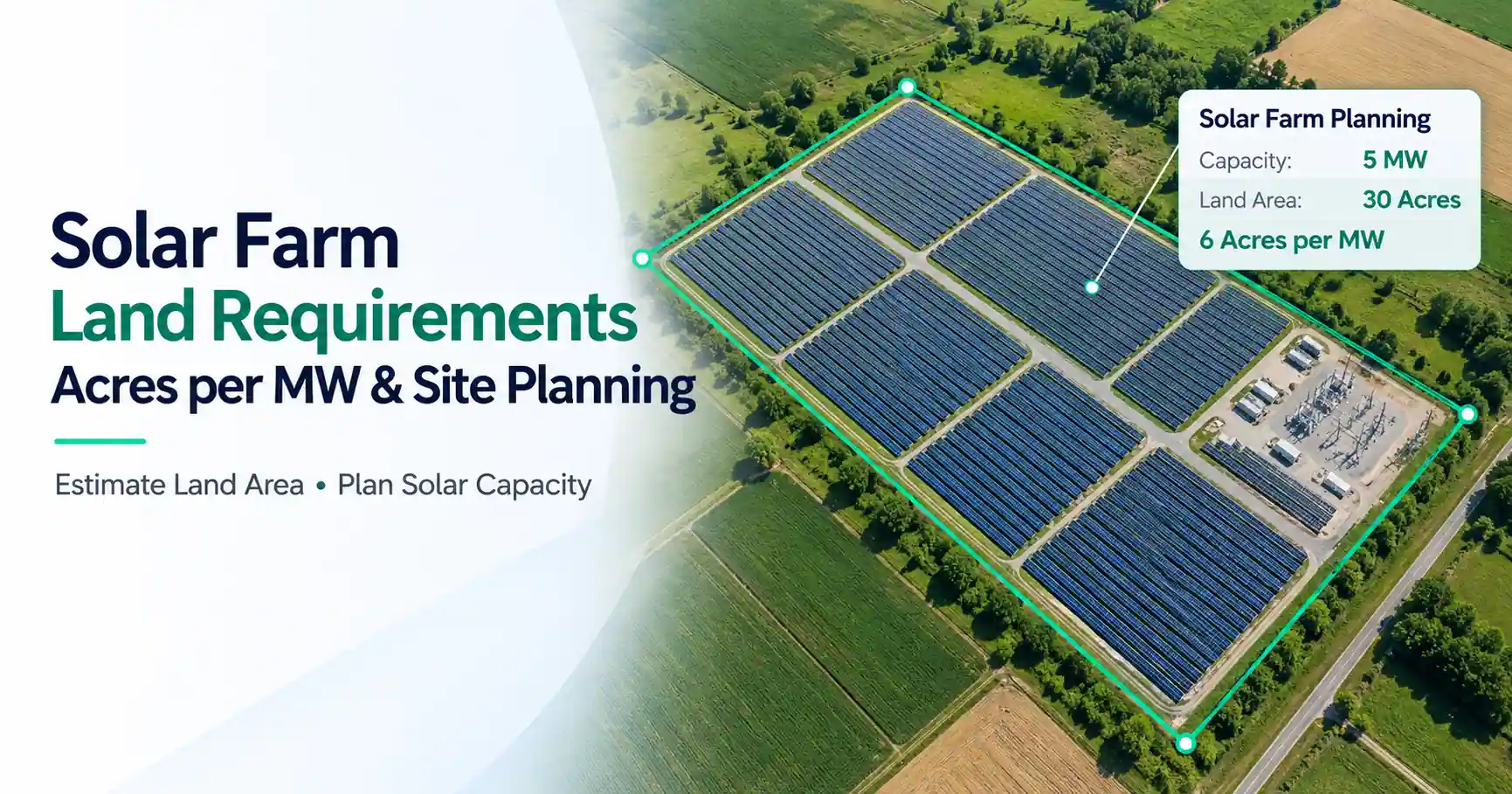
A solar farm may need approximately 5–7 acres per megawatt as an initial planning estimate for certain photovoltaic projects. Actual requirements vary with panel design, tracking equipment, terrain, and the capacity rating used. Roads, substations, drainage, and setbacks also occupy land, so the panel footprint is smaller than the total site.
This range should not be treated as a universal standard. Published estimates may use either AC or DC capacity, which can produce different acreage figures.
What Determines Solar Farm Land Requirements?
Solar farms require more space than the panels physically cover. Panels must be arranged to limit shading and allow access for installation and maintenance.
Fixed-tilt systems hold panels at a set angle, while tracking systems move them to follow the sun. Their spacing needs may differ.
Other land requirements include inverter stations, electrical cables, access roads, substations, and stormwater features.
Terrain also matters. Steep slopes, wetlands, trees, and irregular boundaries can reduce usable acreage.
A 20-acre property with several unsuitable sections may offer less development space than a smaller, open parcel with favorable conditions.
How Many Acres of Solar for 1 MW?
For preliminary planning, some solar projects use an estimate of 5–7 acres per MW. However, the capacity measurement must be clear.
MW AC refers to alternating-current power capacity, while MWp usually describes the rated direct-current capacity of solar modules under standard test conditions.
These ratings are related but not identical.
For example, a project might have 1 MW of AC capacity and a higher DC module rating. Applying the same acres-per-MW figure to both ratings would produce different estimates.
National Renewable Energy Laboratory research also shows that land-use figures vary by technology and whether the measurement includes the entire project site.
Therefore, asking how many acres of solar for 1 MW requires knowing which capacity rating and site footprint are being measured.
Solar Farm Land Requirements by Capacity
The following table uses a hypothetical planning assumption of 6 acres per MW DC to compare project sizes.
Solar Capacity | Illustrative Land Area |
| 1 MW DC | 6 acres |
| 2 MW DC | 12 acres |
| 5 MW DC | 30 acres |
| 10 MW DC | 60 acres |
| 20 MW DC | 120 acres |
| 50 MW DC | 300 acres |
These figures are examples, not guaranteed minimum requirements.
A real project may need more or less land depending on equipment, setbacks, infrastructure, and site conditions.
Land Area per MW Solar Farm in Hectares
Solar land requirements are also expressed in hectares, especially outside the United States.
One acre equals approximately 0.404686 hectares, while one hectare equals about 2.471 acres.
Using the illustrative figure of 6 acres per MW, the equivalent requirement is approximately 2.43 hectares per MW.
When comparing land area per MW solar farm figures in hectares per MW, check the capacity basis.
The same applies to land area per MWp solar farm estimates expressed in hectares per MWp. MWp refers to rated DC module capacity, so it should not be confused with MW AC.
Keeping the units consistent makes comparisons more reliable.
How Many Solar Panels Per Acre?
There is no fixed answer to how many solar panels per acre, because panel sizes and layouts vary.
Module wattage is one important factor. A solar installation rated at 1 MWp would need approximately 1,667 panels if each module were rated at 600 watts.
However, those panels would not necessarily fit on one acre.
The site also needs spacing between rows, maintenance routes, electrical equipment, and other infrastructure.
Tracking systems and fixed-tilt systems may use different arrangements. As panel technology improves, the same capacity may require fewer modules.
A realistic panel count requires both equipment specifications and a suitable site layout.
Is 1, 5, 20, or 40 Acres Enough for a Solar Farm?
The land available influences the possible project size, but acreage alone does not establish feasibility.
One acre may support a small ground-mounted solar installation, although it is generally insufficient for a conventional multi-megawatt utility-scale project.
Five acres could support a smaller installation if the land is suitable and enough space remains for infrastructure.
Twenty acres may accommodate a modest multi-megawatt project under certain layouts.
Forty acres can provide enough space for a larger solar farm, but development still depends on zoning, terrain, grid access, and local approvals.
Even a large, flat property may be unsuitable if the electrical network cannot accept the proposed generation.
How to Measure Land for a Solar Farm Using Satellite Maps
Satellite mapping tools can help landowners estimate property acreage before commissioning a detailed site assessment.
A practical approach involves:
Open a satellite map or land measurement tool.
Search for the property location.
Identify the approximate parcel boundary.
Place connected points around the property.
Close the boundary to calculate its area.
Review the result in acres or hectares.
Identify visible roads, ponds, buildings, and other obstacles.
Estimate the remaining usable area separately.
However, satellite images cannot establish legal property boundaries or confirm grid capacity, environmental restrictions, or planning permission.
The mapped acreage should be treated as an early planning estimate.
Important Factors in Solar Farm Site Planning
A suitable solar farm site needs more than sufficient acreage.
The land should receive good sunlight with limited shading from trees, buildings, or nearby terrain. Ground conditions must also support the proposed mounting equipment.
Electrical infrastructure is especially important. A nearby power line does not automatically mean the grid has enough capacity for a new solar project.
Road access, flood risk, drainage, environmental restrictions, and local zoning rules can also affect development.
Some agricultural properties may have additional land-use requirements.
Before committing to a project, developers generally need technical, legal, and environmental assessments.
How Much Does a 1 Acre Solar Farm Cost?
There is no universal 1 acre solar farm cost because installation expenses depend on project capacity, equipment, location, and infrastructure.
When estimating solar farm cost per acre, separate land expenses from project development expenses.
Land may be purchased or leased. Solar installation costs include panels, mounting structures, inverters, wiring, labor, and related equipment.
Grid connection, engineering, and permits can add substantial expenses.
The cost of a solar farm per acre is therefore not necessarily comparable between different projects.
A more useful approach is to evaluate the cost per installed watt or megawatt while calculating land costs separately.
Anyone asking how much does a 1 acre solar farm cost should first identify the proposed capacity and local development conditions.
How Much Money Can a Solar Farm Make?
Solar farms can generate revenue by selling electricity, but their profitability depends on more than acreage.
A 1-acre, 5-acre, or 20-acre solar project may produce different financial results depending on installed capacity, sunlight, equipment performance, and electricity prices.
Annual electricity revenue depends on the amount of power sold and the price received.
However, revenue is not the same as profit. Operating costs, maintenance, financing, insurance, and taxes must also be considered.
A 20-acre solar farm is not guaranteed to earn four times the income of a 5-acre project.
Similarly, a larger installation does not automatically generate a higher return on investment.
How Much Do Solar Farms Pay Landowners?
Landowners may earn income by leasing suitable property to solar developers.
Lease agreements can provide annual payments based on acreage, project terms, or another negotiated arrangement.
Payment amounts vary according to location, grid access, land quality, project demand, and contract conditions.
Some agreements also include annual rent increases or payments during the development period.
Before signing, landowners should review the lease duration, access rights, tax obligations, insurance, and land restoration requirements.
Lease income is different from the revenue earned by the company operating the solar farm.
Do Solar Farms Devalue Nearby Property?
Solar farms do not have the same effect on property values in every location.
Possible influences include distance from the project, visual screening, nearby development, and local housing market conditions.
Some buyers may have concerns about landscape changes, while others may place little weight on nearby solar infrastructure.
Reliable conclusions require local property market evidence rather than broad assumptions.
What Happens to Solar Farms After 30 Years?
Solar farms do not necessarily stop operating after 30 years.
Solar panels can continue generating electricity for decades, although their output may decline over time.
When a project reaches the end of its planned operating period, the owner may extend operations, replace equipment, or repower the installation.
Another option is decommissioning, which involves removing equipment and restoring the site according to applicable requirements.
The outcome depends on equipment condition, project economics, lease terms, and local rules.
What Are the Disadvantages of Solar Farms?
Solar farms can require significant land areas, which may affect existing agricultural or other land uses.
Other challenges include grid connection expenses, construction disturbance, permitting delays, and visual changes.
Stormwater management, vegetation control, maintenance, and future equipment removal also need planning.
These issues do not make every project unsuitable, but they can increase costs or limit development options.
Careful site selection helps identify potential problems before construction.
Common Mistakes When Estimating Solar Farm Acreage
A common mistake is assuming every acre of a property can hold solar panels. Access roads, setbacks, unsuitable terrain, and equipment areas reduce the available space.
Another error is comparing MW AC with MWp DC without checking the difference.
Landowners may also apply a standard acres-per-MW estimate without considering local conditions.
Finally, acreage alone cannot determine construction cost, electricity production, or financial profit.
Final Thoughts
Solar farm land requirements depend on project capacity, panel spacing, site layout, and infrastructure needs.
Acres per MW provide a useful starting point, but capacity ratings and land-use assumptions must remain consistent.
Satellite maps can help estimate property size, while detailed assessments identify how much land is suitable for development.
Before planning a solar project, consider grid access, local regulations, costs, and long-term land use alongside the available acreage.
Frequently Asked Questions
Some solar PV projects use approximately 5–7 acres per MW for preliminary planning. Actual land requirements depend on whether capacity is measured in AC or DC, along with panel layout and site conditions.
Forty acres may support a multi-megawatt solar installation, depending on usable land, equipment layout, and infrastructure. Grid access, zoning, and environmental restrictions must also be considered before confirming project feasibility.
The number varies with module wattage, physical dimensions, row spacing, and access requirements. There is no universal panel count per acre, so a site-specific layout is needed for a dependable estimate.
Revenue depends on installed capacity, annual electricity generation, and the price received for power. Operating expenses and financing affect profit, so acreage alone cannot establish a reliable annual earnings figure.
Solar lease payments vary by location, contract terms, land suitability, and market demand. Agreements may provide annual rent or other negotiated payments. There is no standard payment rate that applies to all properties.
A solar farm may continue operating, receive upgraded equipment, or be decommissioned after its planned operating period. The decision depends on equipment performance, project economics, lease agreements, and applicable regulations.