



Learn how to calculate land area using length and width with simple formulas and practical examples. Discover how to measure plots, convert square feet into acres, and estimate irregular land areas.
A property listing might give a plot's length and width without stating its total area. If you know how to calculate land area, those two numbers can tell you a lot about the space available for a home, garden, or small farm. The method is especially useful for square and rectangular plots, where straight boundaries meet at right angles.
Land sizes can be recorded in square feet, square meters, square yards, or acres. This guide covers the basic formula, common conversions, irregular plots, and ways to check measurements before making a property decision.
How to Calculate Land Area from Length and Width
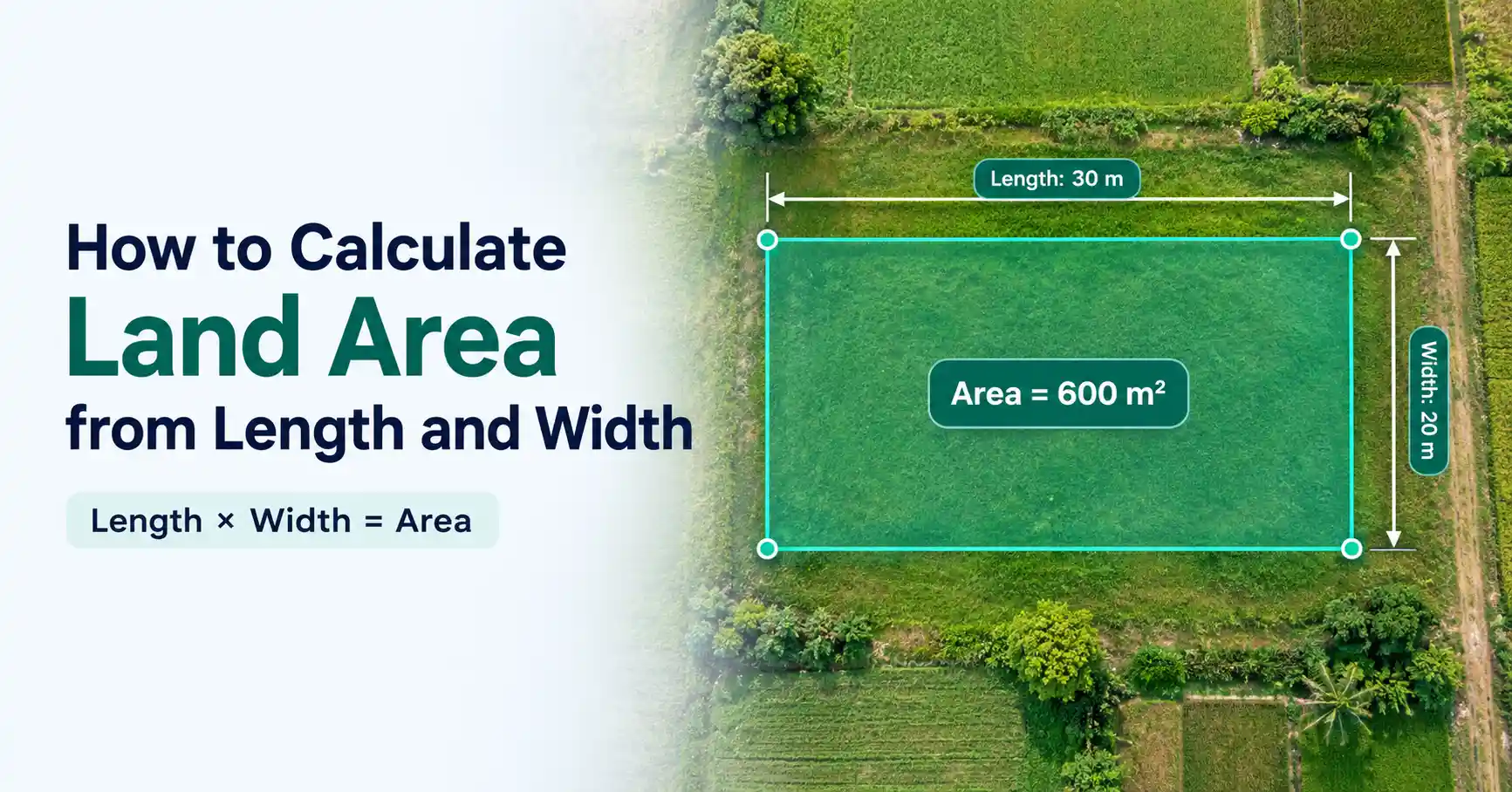
For a rectangular plot, multiply its length by its width to find the area. Measurements in feet give an answer in square feet; measurements in meters give square meters. A rectangular plot that is 30 feet long and 50 feet wide covers 1,500 square feet. This method works when the sides form right angles.
The basic formula is Land area = length × width. Both dimensions must use the same unit. If you measured one side in feet and the other in meters, convert one measurement before multiplying.
What Is the Land Area Calculation Formula?
The standard land area calculation formula depends on the shape. For a rectangle, use length multiplied by width. For a square, multiply one side by itself because all four sides are equal.
When learning how to find area using length and width, check the corners. A four-sided plot with sloping sides or angles other than 90 degrees may not be a rectangle, even if two measurements are available.
How to Calculate Land Area in Square Feet
To understand how to calculate land area in square feet, measure both sides of a rectangular plot in feet and multiply them. For example, a lot measuring 40 feet wide and 60 feet long covers 2,400 square feet.
How Many Square Feet Is a 30×50 Plot?
A rectangular 30-by-50-foot plot contains 1,500 square feet. The result comes from multiplying 30 by 50, with both dimensions measured in feet.
That area is approximately 0.0344 acres. If the dimensions were in meters instead, the answer would be 1,500 square meters, not square feet.
How to Calculate Land Area in Square Meters
To learn how to calculate land area in square meters, use the same length-times-width method, but measure both sides in meters. A rectangular plot measuring 20 meters by 30 meters covers 600 square meters.
Square meters are common in metric land records and building plans. One square meter equals about 10.764 square feet, so you can convert an area between the two systems when comparing listings.
How to Calculate Land Area in Acres
For anyone researching how to calculate land area in acres, the first step is finding the area in square feet or square meters. Then convert that area to acres.
One acre equals 43,560 square feet, or approximately 4,046.86 square meters. A 43,560-square-foot lot is one acre, while a 21,780-square-foot lot is half an acre.
If your plot measures 100 feet by 200 feet, it covers 20,000 square feet. Dividing that by 43,560 gives roughly 0.46 acres.
When working with meters, divide the area in square meters by about 4,046.86 to estimate the number of acres.
How to Calculate Plot Area in Different Units
When comparing land records, you may need to know how to calculate plot area in a different unit. The underlying area stays the same; only the way it is expressed changes.
Unit | Equivalent Area |
| 1 square yard | 9 square feet |
| 1 square meter | About 10.764 square feet |
| 1 acre | 43,560 square feet |
| 1 acre | About 4,046.86 square meters |
| 1 hectare | 10,000 square meters |
For example, a 900-square-foot parcel covers 100 square yards.
How to Measure Land Length and Width
Before calculating area, you need dependable measurements. A tape measure can work for a small, clear plot, while a measuring wheel may be more convenient for longer, accessible boundaries. Existing survey plans can provide dimensions that are difficult to collect yourself.
If you are learning how to measure land area on the ground, first identify the correct boundary points. Do not assume the edge of a lawn or fence matches the legal property line. Measure along the actual sides and record the units as you go.
GPS-enabled maps can offer rough measurements when you cannot walk every boundary. For high-stakes decisions, rely on an appropriate professional survey.
How to Calculate Irregular Land Area
Knowing how to calculate irregular land area takes more than one length and one width. A plot may have angled sides, curved edges, or several corners, so treating it as a rectangle can give an inaccurate answer.
One practical approach is to divide a simple irregular shape into smaller rectangles and triangles. Find the area of each part, then add the results. A right triangle uses half its base multiplied by its perpendicular height. Make sure you do not count overlapping areas twice.
For more complex land, accurate corner coordinates or a survey plan may be needed. A digital area tool can help estimate the enclosed space after you mark its boundary points, but the result depends on how precisely you place them.
Can You Calculate Land Area on Google Maps?
Google Maps can help you inspect a location and measure distances between selected points. However, its standard Measure distance feature reports length rather than automatically calculating the area inside a property boundary.
For a basic area estimate, you could use a tool designed to measure enclosed shapes, such as FieldCalc's Map Area Calculator. Google Earth also offers area measurement features in supported interfaces.
These tools are useful for early planning, not for proving ownership or settling boundary disputes.
Common Mistakes When Calculating Land Area
One easy mistake is mixing units. Multiplying a length in feet by a width in meters will not give a useful square-foot or square-meter answer until the units match.
Another is confusing area with perimeter. A long, narrow lot can have the same area as a compact one even though their boundary lengths differ. Shape also matters: multiplying the longest length by the widest width of an irregular parcel often overstates its true area.
When Should You Use a Land Surveyor?
A simple calculation is usually enough for classroom problems, rough landscaping plans, or early property comparisons. It is not always enough when a boundary must be legally verified.
A qualified land surveyor may be needed before a purchase, a construction project near a boundary, or a dispute with a neighbor.
If your land is irregular or its corners are unclear, getting a reliable survey can save you from planning around an incorrect estimate.
Final Thoughts
For rectangular land, calculating area starts with multiplying length by width in matching units. You can then express the answer in square feet, square meters, square yards, or acres. A 30-by-50-foot plot, for example, covers 1,500 square feet.
Irregular plots need extra measurements, and digital maps are best treated as estimating tools unless supported by suitable survey data. Once you understand how to calculate land area, you can compare properties more confidently while knowing when professional measurement is necessary.
Frequently Asked Questions
For a rectangle, multiply its length by its width. If both dimensions are in feet, the result is square feet. If both are in meters, the result is square meters. This method assumes the corners form right angles.
For a rectangular plot, area equals length times width. A square uses side times side. More complex shapes may need to be split into smaller sections or measured using boundary coordinates.
First multiply the two dimensions to find the area. If both are in feet, divide the square-foot result by 43,560. For dimensions in meters, divide the square-meter result by about 4,046.86.
If the plot is rectangular and the measurements are in feet, its area is 1,500 square feet. The same numbers in meters would describe 1,500 square meters, so confirm the units first.
The basic Measure distance feature in Google Maps measures lengths, not enclosed areas. A dedicated map-area calculator or supported Google Earth area tool can estimate a plot's area from marked boundary points.
For a manageable shape, divide the land into rectangles and triangles, calculate their areas, and add the results. Complex boundaries may require mapped coordinates or a survey. Avoid using only maximum length and width as if the whole plot were rectangular.