



Not every room, plot, or floor plan is a perfect rectangle. Learn how to break irregular shapes into simple sections, calculate each area, and measure unusual spaces with confidence.
A room, garden, field, or floor plan does not always form a neat square or rectangle. Some spaces have extra corners, sloping edges, or sections that stick out. So, how do you calculate the area of an irregular shape when one basic formula does not fit?
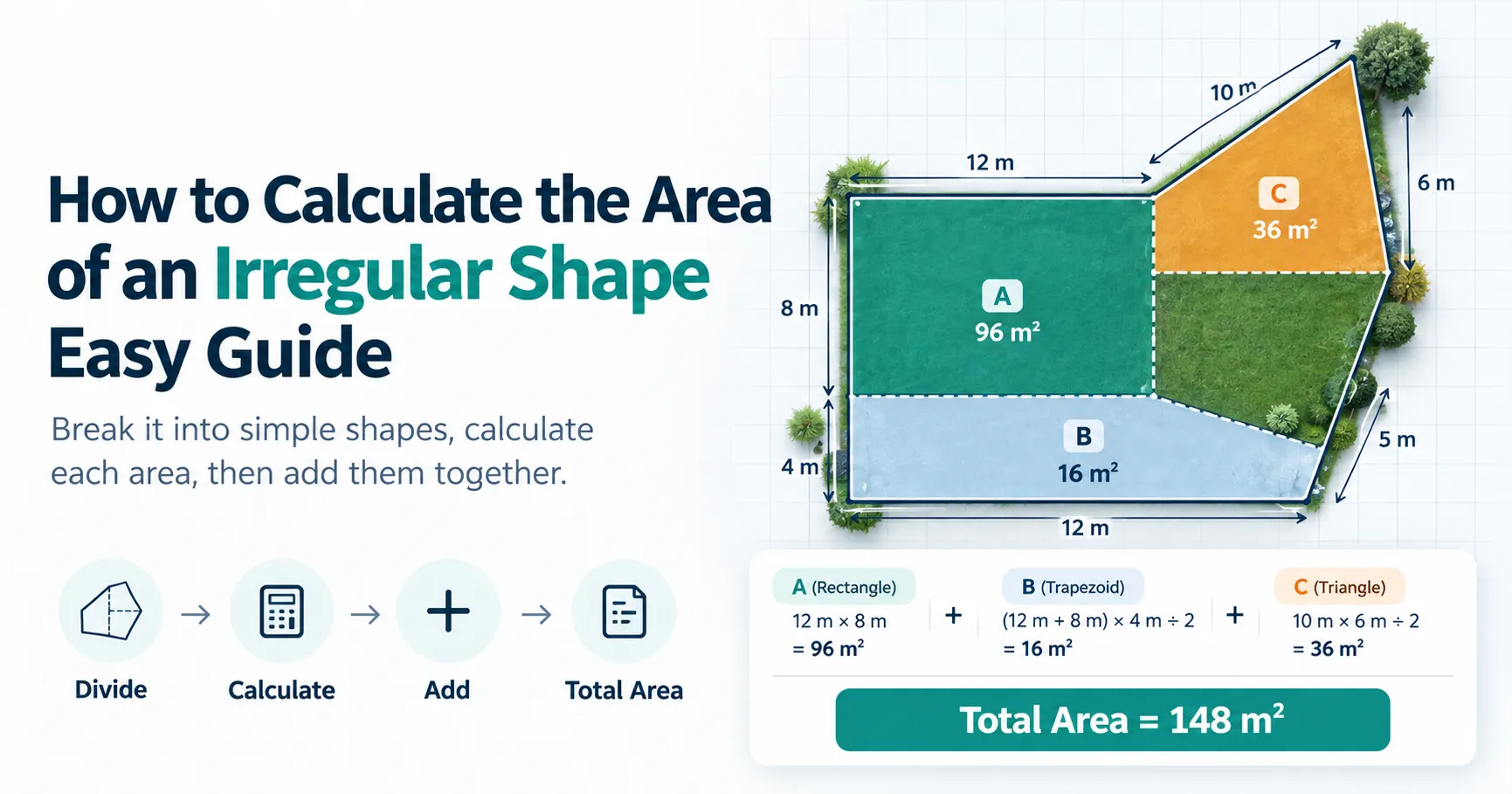
The easiest approach is often to break the shape into smaller figures you already know, such as rectangles, triangles, squares, or trapezoids. You can calculate each part separately and then combine the results. This method works for many school problems, room layouts, and land measurements. The key is choosing the right formulas, using consistent units, and avoiding overlaps or missing sections.
How Do You Calculate the Area of an Irregular Shape?
To find an irregular shape's area, divide it into simpler shapes such as rectangles, squares, triangles, or trapezoids. Calculate each section with the correct area formula, then add the results. If your larger shape contains a missing cut-out, calculate that section and subtract it instead.
A simple process is:
Sketch the shape.
Split it into familiar figures.
Measure each section.
Calculate every area.
Add the sections together.
Subtract any excluded parts.
This is also a practical way to understand how to work out the area of an irregular shape without needing one complex formula.
What Is an Irregular Shape?
An irregular shape is a two-dimensional figure that does not match one simple standard shape throughout.
For example, an L-shaped room is irregular because you cannot measure it accurately with one length × width calculation. You first need to break it into smaller rectangles.
An irregular polygon may also have sides or angles of different sizes. The area of irregular shapes can still be calculated, but the method depends on the information available.
Remember that area is the space inside a boundary. Perimeter is different: it measures the distance around the outside.
Basic Area Formulas You Need
Before working with unusual figures, it helps to know the basic formula for the area of common shapes.
Rectangle
Area = Length × Width
Example:
8 ft × 5 ft = 40 sq ft
Square
Area = Side × Side
Example:
6 ft × 6 ft = 36 sq ft
Triangle
Area = (Base × Height) ÷ 2
Example:
10 ft × 6 ft ÷ 2 = 30 sq ft
Trapezoid
Area = ((a + b) × h) ÷ 2
Here, a and b are the two parallel sides, while h is the perpendicular height.
Circle
Area = π × Radius²
These formulas are the starting point when learning how to calculate area for more complex figures.
How to Find the Area of Unusual Shapes
The simplest way to find the area of unusual shapes is usually to divide them into smaller parts.
Imagine an L-shaped floor that can be split into two rectangles.
Rectangle A:
8 ft × 5 ft = 40 sq ft
Rectangle B:
4 ft × 3 ft = 12 sq ft
Add them:
40 + 12 = 52 sq ft
The total floor area is 52 square feet.
Another option is subtraction. Suppose an irregular figure looks like a large rectangle with a smaller rectangular section removed. Find the area of the full rectangle, calculate the missing section, and subtract it.
Large area − missing area = irregular area
This can be faster than dividing the figure into several separate sections.
How to Calculate the Area of an Irregular Polygon
An irregular polygon can often be divided into triangles, rectangles, or trapezoids. Calculate each smaller piece and add the results.
However, side lengths alone are not always enough.
For some polygons, you may also need:
Perpendicular heights
Diagonals
Angles
Coordinates
Survey measurements
For example, two different four-sided figures can have the same four side lengths but different areas because their angles are different.
So, if you are given an area of random shape problem, first check what measurements are available. A correct area calculation depends on having enough geometric information.
How to Find the Area of a 3-Sided Shape
A three-sided shape is a triangle. Its area is calculated using a base and a perpendicular height.
The formula is:
Area = (Base × Height) ÷ 2
Suppose a triangle has:
Base = 10 ft
Height = 6 ft
Then:
10 × 6 ÷ 2 = 30 sq ft
The area is 30 square feet.
If you are wondering how to find base area, remember that the base is simply the side chosen for the calculation. The height must meet that base at a right angle.
A sloping side is not automatically the height.
How to Find the Area of 4 Unequal Sides
A four-sided figure is called a quadrilateral. If its sides or angles are not all equal, it may be described as an irregular quadrilateral.
There is no universal formula that finds its exact area from four side lengths alone.
One useful method is to draw a diagonal from one corner to the opposite corner. This divides the quadrilateral into two triangles.
Then:
Measure or determine the shared diagonal.
Find the perpendicular height of each triangle.
Calculate both triangle areas.
Add them together.
This method works when you have enough measurements.
So, a shape with four unequal sides can still be measured, but you may need more than the four edge lengths.
How to Calculate the Area of an Irregular Quadrilateral
A practical method for an irregular quadrilateral is to split it into two triangles.
Suppose a diagonal measures 10 feet. One triangle has a perpendicular height of 4 feet, while the other has a height of 6 feet.
Triangle 1:
10 × 4 ÷ 2 = 20 sq ft
Triangle 2:
10 × 6 ÷ 2 = 30 sq ft
Add the two results:
20 + 30 = 50 sq ft
The quadrilateral covers 50 square feet.
This example works because both triangle heights are known. Without heights, angles, coordinates, or other useful measurements, the exact area may not be possible to determine.
How Children Can Calculate Irregular Shapes
For younger students, irregular area is often taught with grid squares instead of complex formulas.
A child can draw or view the shape on squared paper and count the complete squares inside it.
For a simple composite shape, another method is to divide it into rectangles.
For example, an L-shape might contain one rectangle covering 12 squares and another covering 6 squares.
12 + 6 = 18 square units
Partial grid squares may sometimes be combined to make whole squares.
This visual method helps students understand that area measures the amount of space inside a shape.
How to Calculate the Area of Land With Unequal Sides
Land often forms an irregular polygon rather than a perfect rectangle. The calculation method depends on the boundary and the measurements available.
For a simple parcel, you may divide the land into triangles or rectangles. Calculate each section and add the results.
For more complex property boundaries, other information may be more useful, such as:
Survey coordinates
Boundary points
Measured diagonals
GPS or mapped points
GIS data
A map area calculator can also estimate an irregular boundary by marking points around the land.
Hand calculations may be fine for general estimates. For legal property boundaries, ownership disputes, or official measurements, rely on professional survey data.
How to Calculate Acreage of an Irregular Lot
Once you know the total land area in square feet, converting it to acres is straightforward.
1 acre = 43,560 square feet
Suppose an irregular property contains 87,120 sq ft.
Calculate:
87,120 ÷ 43,560 = 2 acres
So, the lot covers 2 acres.
The irregular shape does not change the conversion. The main challenge is calculating the total square footage accurately first.
For metric land measurements:
1 hectare = 10,000 square meters
Always convert only after you have found the complete area in one consistent unit.
Common Mistakes When Finding Irregular Area
One common error is confusing area with perimeter. Measuring all outer edges gives you the perimeter, not the amount of space inside.
Other mistakes include:
Using the wrong formula for a section
Mixing feet and meters
Using a sloping side instead of perpendicular height
Forgetting one section
Counting overlapping areas twice
Assuming four side lengths always determine a quadrilateral's area
Rounding measurements too early
Using inaccurate land boundary points
Units also matter. If measurements are in feet, the result should be square feet. If they are in meters, the result should be square meters.
Keeping a simple sketch with labels can prevent many errors.
When Should You Use a Map or Area Calculator?
Manual calculations work well for rooms, diagrams, school exercises, and simple land shapes.
A digital map or GIS-based area tool can be more useful when boundaries are large, curved, or difficult to measure by hand.
These tools may use geographic coordinates or boundary points to calculate the enclosed area.
However, digital results depend on how accurately the boundary is marked. Selecting the wrong corner or placing points outside the real property line can change the result.
For rough planning, map tools can be convenient. For legal or high-accuracy land measurement, professional surveying remains more appropriate.
Final Thoughts
If you need to know how do you calculate the area of an irregular shape, start by looking for smaller shapes hidden inside it. Divide the figure into rectangles, triangles, squares, or trapezoids, calculate each area, and then add or subtract as needed.
Keep your units consistent and make sure you have enough measurements. For irregular land, coordinates or survey data may be needed. There is no single formula for every unusual shape, but breaking a complex boundary into manageable parts makes most area problems much easier.
Frequently Asked Questions
Divide the polygon into simple shapes such as triangles, rectangles, or trapezoids. Find the area of each part and add the results. Some irregular polygons also require extra information such as heights, diagonals, angles, or coordinates before an exact area can be calculated.
A four-sided shape with unequal sides can often be divided into two triangles by drawing a diagonal. Calculate each triangle using its base and perpendicular height, then add the two areas. The four side lengths alone may not always be enough.
A four-sided polygon is a quadrilateral. If its sides or angles do not follow a regular pattern, it may be called an irregular quadrilateral. Some four-sided figures may also fit a more specific category, such as a trapezoid.
Use the formula that matches the figure. Rectangles use length × width, squares use side × side, triangles use base × height ÷ 2, and circles use π × radius². Irregular figures can often be divided into these simpler shapes.
Divide simple land parcels into triangles or rectangles and calculate each section. For complex boundaries, survey coordinates, mapped boundary points, GIS tools, or land area calculators may be more suitable. Use professional survey data when legal boundary accuracy matters.
First calculate the lot's complete area in square feet. Then divide the result by 43,560, because one acre contains 43,560 square feet. For example, a parcel measuring 43,560 square feet equals exactly 1 acre.