





Need to find the square footage of a room or space? Learn the basic formula, follow simple measurement steps, convert feet and inches, and calculate regular or irregular areas with practical examples.
Knowing the size of a space is useful when you are buying flooring, comparing rooms, estimating materials, or working on a home project. If you need to learn how to calculate square feet, the math itself is usually simple. For a rectangular space, you need its length and width.
The important part is measuring in consistent units and using the right formula for the shape. A square or rectangle takes only one multiplication. Spaces with extra corners may need to be split into smaller sections first. Below, you will find practical methods for rooms, irregular areas, feet-and-inch measurements, and several common dimensions.
How Do You Calculate Square Feet?
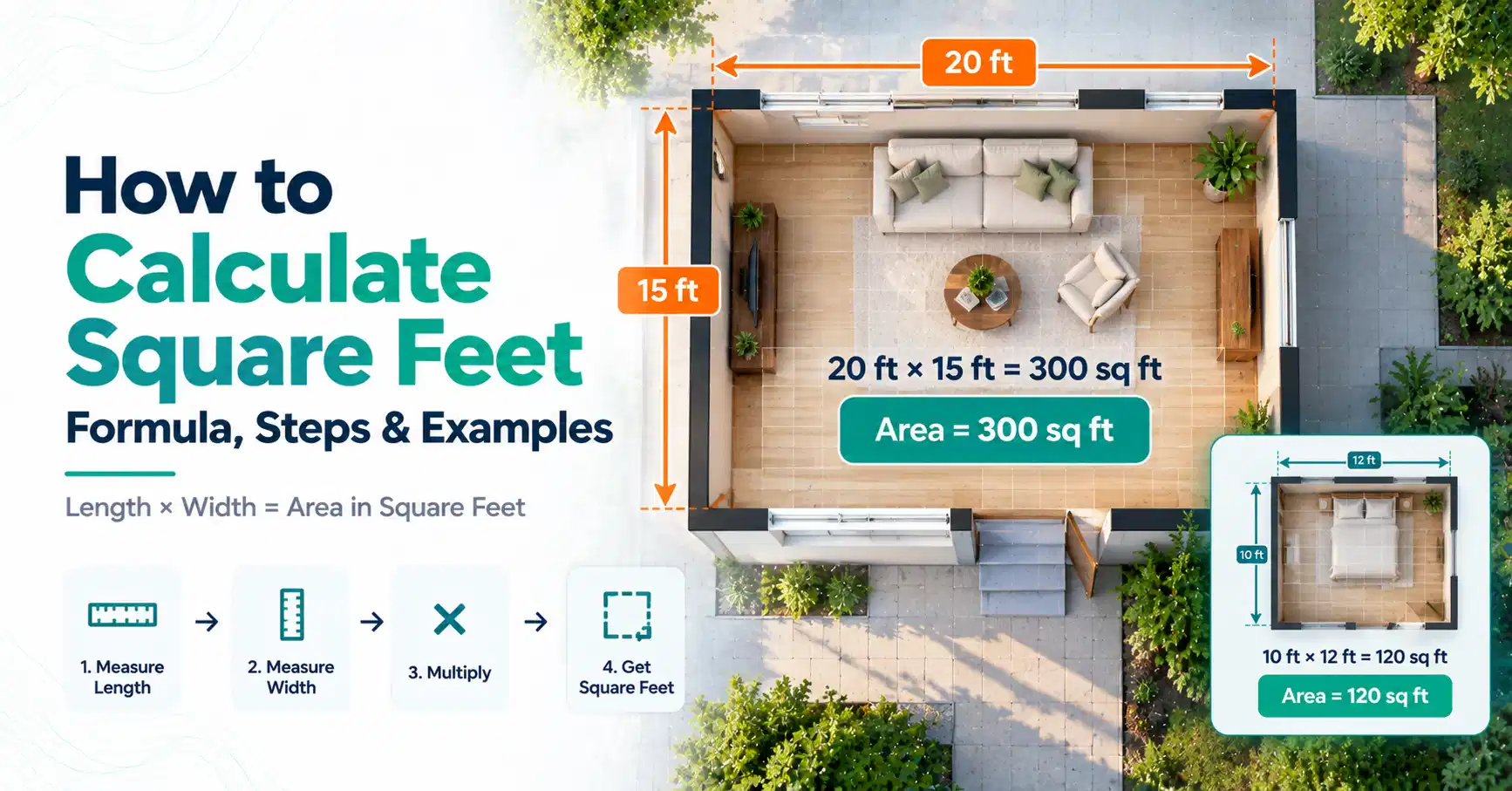
For a square or rectangular area, measure the two sides in feet and multiply them together. The basic square footage formula is:
Square Feet = Length (ft) × Width (ft)
For example, if a floor is 12 feet long and 12 feet wide:
12 × 12 = 144 sq ft
So, the floor covers 144 square feet. This is the simplest way to understand how to calculate square footage when the space has straight, rectangular sides.
What Does Square Footage Mean?
Square footage tells you how much two-dimensional surface an area covers. One square foot is the space inside a square with sides that are each 1 foot long.
Picture a tile measuring 1 foot by 1 foot. That tile covers:
1 × 1 = 1 square foot
A foot contains 12 inches, but a square foot contains 144 square inches because both dimensions must be considered:
12 inches × 12 inches = 144 square inches
This is also why linear feet and square feet are different. Linear feet describe a distance. Square feet describe an area.
For instance, knowing that a wall is 10 feet long does not tell you its area. You would also need its height.
How to Measure Square Feet Step by Step
The easiest approach to how to measure square feet is to work with one unit from the start. A tape measure can give you the dimensions you need.
- Measure the longest direction of the area and record it as the length.
- Measure across the area to get its width.
- If your measurements include inches, convert them before doing the final multiplication.
- Multiply the length by the width.
- Label your answer in square feet, written as sq ft or ft².
Imagine a floor that is 15 feet in one direction and 10 feet in the other.
15 × 10 = 150
The floor covers 150 sq ft.
Notice that the result is not 150 feet. Length and width were multiplied, so the answer represents area.
How to Calculate Square Feet of a Room
If your room is a rectangle, take two wall-to-wall floor measurements. Suppose a bedroom is 12 feet from one wall to the opposite wall and 10 feet across.
Its area is:
12 × 10 = 120 sq ft
So, the room contains 120 square feet of floor space.
This is the basic method for how to work out square feet of a room. It also works for offices, garages, kitchens, sheds, and other rectangular spaces.
Before measuring, decide what you need to include. A closet may matter when calculating total floor area but may not matter for a project limited to the main part of a room.
Alcoves and extensions also need attention. If they do not fit inside the main rectangle, measure them as separate sections and add them later.
How to Calculate Square Footage of a Square Room
A square is even easier because its length and width are equal. Measure one side, then multiply that number by itself.
The formula is:
Area = Side × Side
For a 10-foot square room:
10 × 10 = 100 sq ft
For a 12-foot square room:
12 × 12 = 144 sq ft
For a larger 30-foot square area:
30 × 30 = 900 sq ft
Therefore, a 10×10 area is 100 square feet, a 12×12 room is 144 square feet, and a 30×30 area covers 900 square feet.
Common Square Footage Examples
The same calculation can be used for many common room, building, and plot dimensions.
Dimensions | Calculation | Area |
| 10 ft × 10 ft | 10 × 10 | 100 sq ft |
| 12 ft × 12 ft | 12 × 12 | 144 sq ft |
| 20 ft × 30 ft | 20 × 30 | 600 sq ft |
| 30 ft × 30 ft | 30 × 30 | 900 sq ft |
| 30 ft × 40 ft | 30 × 40 | 1,200 sq ft |
The rule stays the same for rectangles of different sizes. A 30-foot by 40-foot area, for example, covers 1,200 sq ft.
Why Do You Divide by 144 to Get Square Footage?
You divide by 144 when your area is in square inches and you want the answer in square feet.
A single foot has 12 inches. For area, both sides of the square contain 12 inches:
12 × 12 = 144 square inches
That means:
144 sq in = 1 sq ft
Suppose you calculated an area of 1,440 square inches. To change the unit:
1,440 ÷ 144 = 10 sq ft
There is an important difference here. If your starting measurements are already in feet, you do not divide the final answer by 144.
For example:
8 ft × 10 ft = 80 sq ft
The calculation is already in square feet, so no further conversion is required.
Is 12 × 12 Inches One Square Foot?
Yes. A space that is 12 inches long and 12 inches wide covers one square foot.
The calculation is:
12 × 12 = 144 sq in
Since 144 square inches make one square foot, the result is:
144 ÷ 144 = 1 sq ft
The unit is what makes this different from a 12×12-foot room.
12 in × 12 in = 1 sq ft
12 ft × 12 ft = 144 sq ft
Always check whether a measurement is given in inches or feet before calculating.
How to Calculate Square Feet With Feet and Inches
Real rooms are not always exactly 10 feet or 12 feet wide. You might measure a wall at 10 feet 6 inches.
Convert the extra inches into a fraction or decimal of a foot first. Divide the inches by 12:
6 ÷ 12 = 0.5
Therefore:
10 ft 6 in = 10.5 ft
If the other dimension is 12 feet:
10.5 × 12 = 126 sq ft
This room covers 126 square feet.
Another example is 9 feet 3 inches. Three inches is one-quarter of a foot:
3 ÷ 12 = 0.25
So, 9 feet 3 inches becomes 9.25 feet before you use it in the area formula.
How to Figure Out Square Footage of an Irregular Room
An L-shaped room cannot be measured accurately as one large rectangle if part of that rectangle does not actually belong to the room. A better way to figure out square footage is to break the floor plan into simple pieces.
Start by sketching the room. Draw lines that separate it into rectangles or squares. Measure and calculate each part on its own.
For example, imagine an L-shaped room that can be separated into two areas:
Main section = 100 sq ft
Smaller section = 40 sq ft
Combine them:
100 + 40 = 140 sq ft
The complete room covers 140 square feet.
This method also makes it easier to determine square feet for rooms with extensions, alcoves, or unusual layouts. Just make sure sections do not overlap, or you may count the same area twice.
How to Calculate Square Footage for Other Shapes
The length × width rule is designed for rectangles. Other shapes need different formulas.
For a rectangle:
Area = Length × Width
For a square:
Area = Side × Side
For a triangle:
Area = (Base × Height) ÷ 2
Area = π × Radius²
If a space combines several shapes, calculate each piece with the correct formula and then add the results.
For example, a floor might contain one large rectangle and a smaller triangular section. Find the area of each separately instead of trying to force the entire layout into one formula.
Common Mistakes When Measuring Square Footage
Many incorrect results come from the units rather than the multiplication itself. Mixing feet and inches is a common example. Convert the measurements to matching units before calculating.
Also watch for these mistakes:
- Treating a length measurement as an area
- Writing ft when the answer should be sq ft
- Dividing by 144 even though the original dimensions were in feet
- Leaving an alcove out of the total when it should be included
- Counting the same section twice in an irregular room
- Measuring an L-shaped room as if it were one full rectangle
- Multiplying feet by inches without converting one of the units
A quick sketch with measurements written beside each wall can help prevent errors in complicated spaces.
When Is Square Footage Useful?
Square footage gives you a practical way to compare and plan physical spaces. You may use it when estimating flooring, carpet, tile, construction materials, landscaping areas, room layouts, or renovation work.
It can also help when comparing the size of rooms or properties.
Keep in mind that measured area is not always the exact amount of material you should purchase. Tile, flooring, and similar projects can require additional material for cuts, patterns, waste, or installation needs.
Final Thoughts
The simplest answer to how to calculate square feet is to measure a rectangular area's length and width in feet and multiply them. Keep the units consistent before doing the math.
For measurements that include inches, convert the inches to feet first. For irregular rooms, split the floor into smaller shapes and combine their areas. Divide by 144 only when changing square inches into square feet. With the correct units and a few careful measurements, you can calculate the area of most everyday spaces without complicated math.
Frequently Asked Questions
If both sides are 12 feet, the room covers 144 square feet. The calculation is 12 multiplied by 12. The answer changes completely if the dimensions are in inches, so always check the measurement unit before calculating an area.
If the measurements are 30 feet and 40 feet, the total is 1,200 square feet. This comes from multiplying 30 by 40. You can use the same calculation for any rectangular space when both dimensions are given in feet.
A 20-foot by 30-foot rectangle covers 600 square feet because 20 multiplied by 30 equals 600. No conversion is needed because both dimensions already use feet. The final unit is square feet because you are calculating area rather than length.
For a rectangle, record the length and width in feet and multiply the two measurements. If the room has an unusual shape, separate it into smaller rectangles or other simple shapes. Find each section's area, then combine those values for the total.
Division by 144 is used when an area is currently expressed in square inches. A 1-foot-by-1-foot square contains 12 inches along each side, giving 144 square inches. Therefore, dividing a square-inch value by 144 converts that area to square feet.
No. A 12-inch by 12-inch square covers 1 square foot, while a 12-foot by 12-foot space covers 144 square feet. The numbers may look identical, but inches and feet represent very different dimensions.