





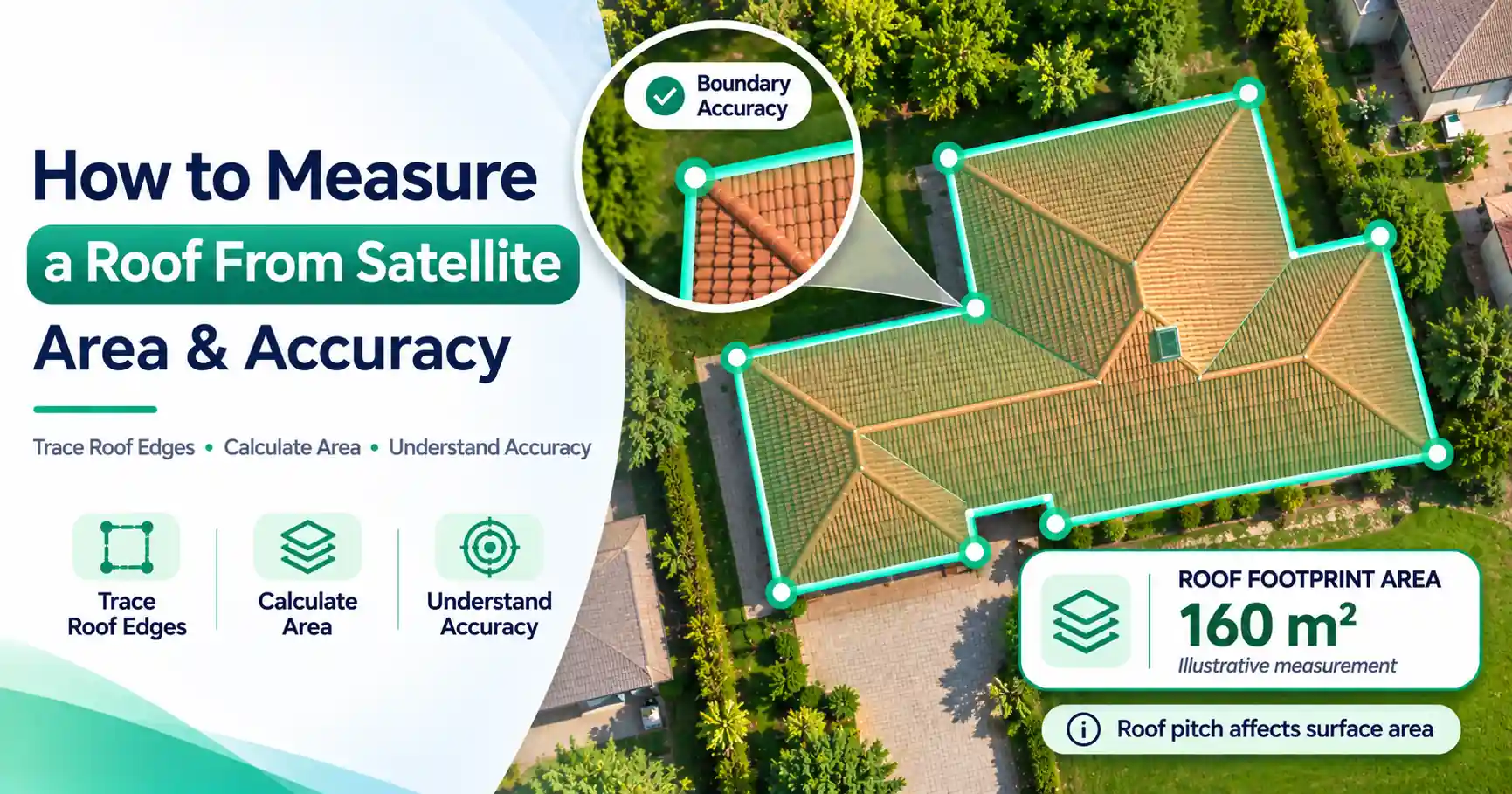
Want to measure your roof without climbing onto it? Learn how to use satellite images to estimate roof area, calculate square footage, apply roof pitch factors, and determine roofing squares. Explore free measurement methods, accuracy limits, and common mistakes.
Planning a roof replacement but unsure how much roofing material you need? You can measure a roof from satellite images without climbing onto it.
Satellite maps help you estimate roof dimensions, calculate square footage, and plan a roofing budget. However, the area shown on a flat map is not always the actual surface area of your roof.
Sloped roofs have more surface area than their horizontal footprint. Roof pitch, overhangs, and complex shapes can change the final measurement.
This guide explains how to measure roof area online, use a roofing calculator, calculate roofing squares, and understand measurement accuracy.
Can You Measure a Roof From Satellite Images?
Yes, you can measure a roof using satellite or aerial images and an online area measurement tool. By tracing the roof outline, you can estimate its horizontal area. However, you must account for roof pitch to calculate the actual sloped surface area.
Satellite roof measurement is useful for early planning because it does not require physical roof access.
You can estimate the size of a simple roof from a clear overhead image. Complex roofs may need more detailed measurements.
Remember that satellite measurements are estimates, not guaranteed dimensions.
How to Measure a Roof From Satellite: Step-by-Step
You can estimate roof area online by following six simple steps.
Step 1: Find Your Property on a Satellite Map
Open a satellite mapping service and enter your property address.
Zoom in until the roof edges are clearly visible. Use an overhead view rather than a tilted image when possible.
Clear images make it easier to identify corners and roof sections.
Step 2: Identify the Roof Outline
Look closely at the roof's outer edges.
Include visible overhangs when measuring the roof footprint. Avoid tracing the walls or property boundaries instead.
If the roof has several sections, identify each one before starting.
Trees, shadows, and nearby buildings may hide some edges.
Step 3: Trace the Roof Footprint
Use an online area measurement tool to mark points around the roof.
Place points at each visible corner and follow the roof outline.
A roof square footage calculator can estimate the area enclosed by those points.
For complex roofs, measure separate sections when needed.
Step 4: Calculate the Horizontal Area
Once the outline is complete, review the calculated area.
Most area measurement tools support square feet, square meters, or both.
This result represents the horizontal roof footprint.
It does not automatically include the extra surface area created by roof slopes.
Step 5: Account for Roof Pitch
Roof pitch describes how steep a roof is.
A steeper roof has more surface area than a flat roof with the same footprint.
Use a roof pitch factor to adjust the horizontal measurement.
Step 6: Review Your Estimate
Check whether you included all roof sections and overhangs.
Look for hidden corners, dormers, and smaller roof areas.
If the roof has different slopes, calculate those sections separately.
Verify important measurements before ordering roofing materials.
Can You Measure a Roof Using Google Maps?
Google Maps satellite imagery can help you inspect a roof and estimate its dimensions.
Some mapping interfaces offer distance or area measurement features. Available options may differ by device and platform.
However, measuring a roof outline on a flat map does not automatically calculate its sloped surface area.
You may need a separate roof calculator to account for pitch and estimate roofing materials.
For accurate project planning, confirm that the tool measures area rather than only distance.
How to Calculate Roof Square Footage
Understanding how to calculate roof square footage starts with two measurements: horizontal roof area and roof pitch.
Horizontal area is the space covered by the roof when viewed from above.
Sloped surface area includes the extra area caused by the roof's angle.
Use this formula:
Roof surface area = Horizontal roof area × Roof pitch factor
Example: Calculating Roof Square Footage
Suppose a roof has:
- Horizontal area: 1,500 sq ft
- Roof pitch: 6:12
- Roof pitch factor: 1.118
Calculation:
1,500 × 1.118 = 1,677 sq ft
The estimated sloped roof area is 1,677 square feet.
This example assumes the measured roof area has the same pitch throughout.
For roofs with different slopes, calculate each section separately and add the results.
This method helps homeowners calculate roof square footage before requesting roofing estimates.
What Is a Roof Pitch Factor?
A roof pitch factor is a multiplier that converts horizontal roof area into sloped surface area.
Roof pitch is commonly written as a ratio.
For example, a 6:12 roof rises 6 inches for every 12 inches of horizontal distance.
The formula is:
Roof pitch factor = √(1 + (rise ÷ run)²)
For a pitch expressed as X:12:
Roof pitch factor = √(1 + (X ÷ 12)²)
Common Roof Pitch Factors
Roof Pitch | Approximate Pitch Factor |
| 3:12 | 1.031 |
| 4:12 | 1.054 |
| 5:12 | 1.083 |
| 6:12 | 1.118 |
| 8:12 | 1.202 |
| 10:12 | 1.302 |
| 12:12 | 1.414 |
A higher pitch factor means more roof surface area for the same horizontal footprint.
If you do not know your roof pitch, avoid guessing. Check available building plans or ask a roofing professional to determine it.
How to Calculate Roofing Squares From Square Footage
Roofers often measure roofing material in units called roofing squares.
One roofing square equals 100 square feet of roof surface area.
To understand how to calculate roofing squares from square footage, use this formula:
Roofing squares = Roof surface area ÷ 100
For example:
Roof surface area = 1,677 sq ft
1,677 ÷ 100 = 16.77 roofing squares
This means the roof has approximately 16.77 squares of surface area before material waste.
Actual material orders may require additional quantities for cuts, overlaps, roof valleys, and installation details.
The amount of extra material depends on roof complexity and product requirements.
How Accurate Are Satellite Roof Measurements?
Satellite roof measurements can provide useful estimates, but their accuracy varies.
Several factors affect the result.
Image Resolution and Quality
Clear, high-resolution images make roof edges easier to identify.
Blurry images can make corner placement less accurate.
Roof Pitch and Slope
Overhead imagery usually shows horizontal area rather than full sloped surface area.
An incorrect pitch factor can produce an inaccurate roof estimate.
Trees, Shadows, and Obstructions
Trees and shadows may hide roof corners or sections.
Missing these areas can lead to an underestimated roof size.
Complex Roof Designs
Hip roofs, dormers, valleys, and roofs with several slopes require more detailed calculations.
A single outline may not provide enough information for every roof section.
Measurement and Tracing Errors
Placing points outside the roof or missing overhangs changes the calculated area.
Different tools may also produce different results because they use different imagery, outlines, and pitch assumptions.
For final material orders or complex roofing projects, professional verification is recommended.
Free Roof Calculator vs Professional Roof Measurement
A free roof calculator can help estimate roof area, while professional measurement provides more detailed information for roofing work.
Factor | Free Online Roof Calculator | Professional Roof Measurement |
| Main purpose | Early area estimates | Detailed project planning |
| Method | Satellite or aerial imagery | Field measurements or specialized methods |
| Cost | Often free | Usually paid |
| Roof pitch | May require manual input | Can be measured or verified |
| Accuracy | Depends on imagery and inputs | Depends on the measurement method |
| Best use | Budget planning | Final quotes and material orders |
A roof calculator square footage estimate is useful when comparing project costs.
However, a professional measurement may be more appropriate for complex roof shapes or major replacement work.
Choose a method based on the accuracy your project requires.
How Big Is the Roof on a 1,500 Sq Ft House?
A 1,500-square-foot house does not always have a 1,500-square-foot roof.
Roof size depends on the building footprint, number of floors, overhangs, roof shape, and pitch.
For example, consider a single-story home with a horizontal roof footprint of 1,500 square feet.
With a 6:12 pitch:
1,500 × 1.118 = 1,677 sq ft
Its estimated sloped roof area would be 1,677 square feet before material waste.
A two-story home with 1,500 square feet of total living space may have a much smaller roof footprint.
Garages, porches, and roof extensions can also increase the total area.
Actual roof measurements are needed for a reliable estimate.
Common Mistakes When Measuring a Roof Online
Avoid these mistakes when estimating roof area.
1. Measuring the property instead of the roof
Follow the visible roof edges, not the land boundaries.
2. Ignoring roof pitch
Horizontal area is not the same as sloped roof area. Apply the correct pitch factor.
3. Missing roof overhangs
Overhangs extend beyond the walls and add roof surface area.
4. Overlooking smaller roof sections
Dormers, extensions, and roofs with different slopes may require separate calculations.
5. Ordering materials from rough estimates
Check waste, product coverage, and installation requirements before purchasing materials.
When Should You Use a Roofing Calculator?
A roofing calculator is useful when you need a quick estimate before starting a project.
Common uses include planning roof replacement, comparing contractor quotes, estimating roofing squares, and preparing an initial budget.
A roof square footage calculator can also help you understand how roof pitch affects material needs.
For early planning, satellite measurements offer a convenient starting point.
For final construction decisions, verify the roof dimensions and material requirements.
Frequently Asked Questions
Yes. Some free online map measurement tools let you trace a roof outline and estimate its horizontal area. You may need to calculate roof pitch separately to estimate the actual sloped roof surface.
Find the property on a satellite map, identify the roof edges, and trace the outline with an area measurement tool. Calculate the horizontal area, then apply the correct pitch factor to estimate sloped roof area.
Google Maps imagery can help you inspect roof dimensions. Available measurement features depend on the interface. However, flat map measurements do not automatically account for roof pitch, so additional calculations may be needed.
Measure each roof section, include overhangs, and determine the correct pitch. Account for different slopes and roof features. For detailed material orders, professional measurements can help verify the final area.
Yes. Some free mapping and area measurement apps can estimate roof footprints using overhead imagery. Features vary, and not every app calculates sloped roof area or roofing materials automatically.
It depends on the building footprint, number of floors, overhangs, and roof pitch. A 1,500 sq ft horizontal roof footprint with a 6:12 pitch has approximately 1,677 sq ft of sloped surface area.
Roofers commonly use square feet, roofing squares, roof pitch, and linear feet. Square footage measures roof area, while one roofing square equals 100 square feet. Linear measurements help estimate materials for ridges, edges, and valleys.
The best roof estimating software depends on your project. Look for accurate area measurement, pitch adjustment, support for complex roofs, and material estimation features. Professional projects may require more detailed tools than basic online calculators.