




How close can you build a fence to your property line? Learn about fence setback requirements, boundary measurements, local regulations, permits, and neighbor rights. Discover how to measure your property line and avoid common fence placement mistakes.
You want to install a privacy fence in your backyard. The old fence looks like the property boundary, but can you build the new one in the same place?
Before installing it, you need to check the fence setback from property line rules that apply to your land.
Some areas allow fences directly on property boundaries. Others have rules about fence location, height, or distance from roads.
An incorrect fence location can lead to disputes, permit problems, or costly changes.
This guide explains fence setback rules, how to find property boundaries, and how to measure the right location for your fence.
What Is a Fence Setback From Property Line?
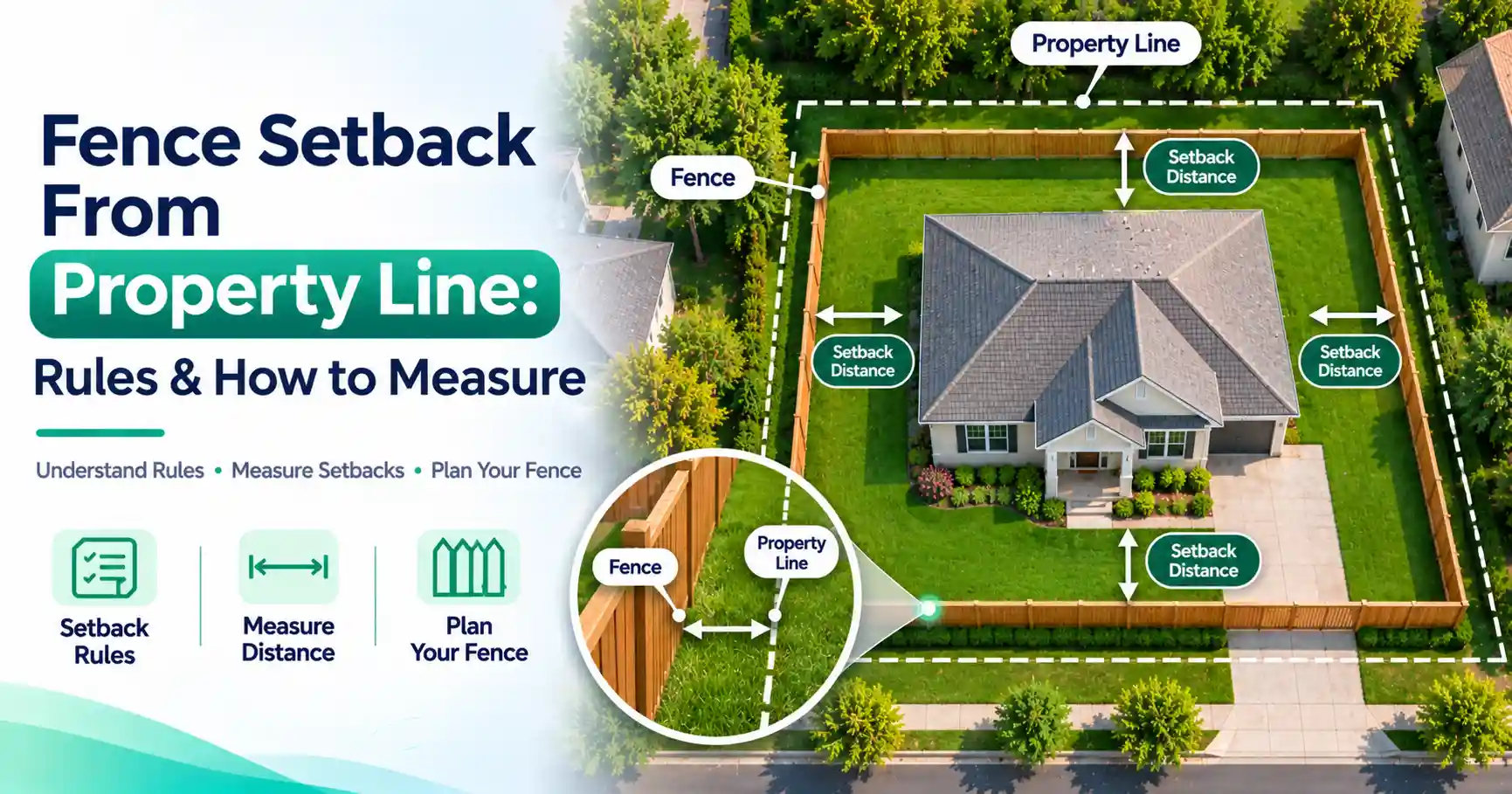
A fence setback is the minimum distance, if any, that a fence must remain from a legal property boundary or another reference line. The required distance depends on local rules, fence location, and other property conditions. Some areas allow fences on property lines without an inward setback.
Fence placement rules may help:
- Prevent fences from crossing property boundaries.
- Maintain clear views near roads.
- Protect access to utilities.
- Reduce conflicts between neighbors.
- Support local land-use plans.
Fence setbacks are not always the same as building setbacks.
A house may need to stay several feet from a boundary, while a fence may follow different rules.
Fence Setback Requirements: What Are the Rules?
Fence setback requirements depend on local zoning ordinances, property conditions, and fence design. There is no single distance that applies to every property in the United States.
Fence property line rules may address:
- Front, side, and rear yard locations.
- Fence height and materials.
- Corner lot visibility.
- Utility easements.
- Public road rights-of-way.
- Fence permits.
- Homeowners association (HOA) restrictions.
For example, a tall privacy fence may face different limits from a short decorative fence.
Local rules may also restrict fences near intersections to protect drivers' views.
Check the fence placement regulations for your property before deciding where to build.
Can I Build a Fence on My Property Line?
Yes, building directly on a property line may be allowed in some locations. However, local laws and property rights determine whether it is permitted.
There are two common situations.
Fence Entirely Inside Your Property
A fence built inside your property stays on land you own.
Its posts, panels, footings, and other parts should remain within the permitted area.
This can help avoid placing the fence on neighboring land.
Fence Directly on a Shared Boundary
A boundary fence may sit on or cross the legal line between two properties.
Such fences can raise questions about:
- Neighbor consent.
- Ownership.
- Maintenance duties.
- Repair costs.
- Shared responsibilities.
The rules vary by state and locality.
Do not assume that your neighbor must share the cost or that permission is never needed.
How Close Can a Fence Be to a Property Line?
The answer to how close can a fence be to a property line depends on the applicable local rules.
Some jurisdictions allow fences at the boundary. Others restrict placement based on height, yard location, or nearby roads.
Fence Location | What to Check |
| Front yard | Height limits, road visibility, right-of-way |
| Side yard | Legal boundary, neighbor concerns |
| Backyard | Boundary location, utility easements |
| Corner lot | Intersection visibility, street frontage |
| Near utilities | Easement access, underground services |
These are common planning concerns, not universal requirements.
A fence allowed along a backyard boundary may face different rules in the front yard.
How to Measure Property Lines for a Fence
Learning how to measure property lines for a fence starts with finding the legal boundary.
A fence, hedge, or driveway edge does not always show where your land ends.
Follow these steps before marking your fence layout.
Step 1: Review Your Property Records
Check your deed, recorded property plat, and any existing survey.
These records may contain lot dimensions, boundary descriptions, and property corner information.
Step 2: Locate Existing Survey Markers
Survey markers may include metal pins or other monuments near property corners.
However, a visible marker may have moved or may not mark your boundary.
Do not rely on an unidentified marker without checking it.
Step 3: Confirm the Legal Boundary
A licensed land surveyor can help locate or establish the property boundary.
This may be necessary when records are unclear or the fence will be close to neighboring land.
Step 4: Check Local Fence Regulations
Find out whether a setback applies.
Also check height restrictions, permits, and special conditions.
Step 5: Measure the Fence Distance
Measure horizontally inward from the correct legal reference line.
The required fence distance from property line boundaries may be measured to a specific part of the fence.
Follow the method stated in the local rule.
Step 6: Mark the Fence Layout
Use stakes and string to mark the proposed fence line.
Check the layout before digging holes.
Step 7: Check Posts and Footings
Make sure the fence panels, posts, and relevant footings comply with the rules.
Do not rely only on the position of the visible fence panels.
Fence Setback Measurement Example
Consider a hypothetical property where the local rule requires a fence to remain 2 feet inside the legal boundary.
The owner has a verified property line and wants to install a straight fence.
The measurement formula is:
Fence setback distance = Horizontal distance from the legal reference line to the fence component specified by the rule
If the rule measures to the nearest part of the fence, that part must stay at least 2 feet inside the boundary.
For example, a panel edge placed 2 feet inside the line may not comply if a post or footing extends closer.
The 2-foot requirement is only an example. It is not a universal fence setback rule.
Fence Setback Requirements by State: Do Rules Differ?
Yes. Fence setback requirements by state can differ because states and local governments may regulate fencing in different ways.
State laws may address certain shared-boundary fence rights and responsibilities.
Cities and counties often regulate fence placement through zoning ordinances.
Other restrictions may come from:
- Subdivision rules.
- Recorded deed restrictions.
- HOA requirements.
- Road access rules.
- Utility easements.
Even two cities in the same state may have different fence rules.
For accurate requirements, identify your governing jurisdiction and review its current fence ordinance.
A statewide summary alone may not cover every local restriction.
Do You Need a Permit to Build a Fence?
A fence permit may be required, depending on your location and the proposed fence.
Permit rules can depend on:
- Fence height.
- Fence location.
- Materials and design.
- Property type.
- Special zoning districts.
Some smaller fences may be exempt from permits.
However, a permit exemption does not automatically remove property boundary or zoning restrictions.
If your property belongs to an HOA, separate approval may also be required.
Check both government rules and any applicable private restrictions.
Can You Build a Fence Inside a Building Setback?
Yes, some local rules allow fences in areas where buildings cannot be placed.
A building setback controls the location of certain structures, such as houses or garages.
Fences may follow separate requirements.
However, a fence inside a building setback can still face restrictions related to height, visibility, easements, or road access.
For example, a front yard fence may be allowed closer to the road than a house, but its height may be limited.
Always check fence-specific rules rather than assuming building setback requirements apply.
Fence Placement Near Easements and Roads
An easement is a legal right that allows certain use of land owned by someone else.
Utility easements may provide access to underground pipes, power lines, or other services.
A right-of-way may involve land or legal rights used for roads, travel, or public access.
A fence can interfere with these rights even when it stands on privately owned land.
Some easements restrict construction or require access for maintenance.
Roadside fences may also face visibility and location limits.
Review recorded easements and local road rules before installing posts.
What Happens If a Fence Crosses the Property Line?
A fence may create an encroachment when it extends onto neighboring land without the required legal right or permission.
This can lead to several problems:
- Neighbor complaints.
- Boundary disputes.
- Requests to move the fence.
- Permit or code enforcement issues.
- Legal proceedings.
The outcome depends on local law and the facts of the case.
For example, a neighbor may challenge a newly installed fence that crosses a surveyed boundary.
Confirming the property line before installation can reduce the risk of expensive corrections.
Common Mistakes When Measuring Fence Setbacks
These mistakes can cause problems during fence installation.
1. Assuming an old fence marks the boundary
Older fences may not follow legal property lines. Check survey records.
2. Relying only on online parcel maps
Digital parcel boundaries may be approximate. Use verified boundary information.
3. Ignoring posts and footings
The full fence structure may matter when checking compliance.
4. Applying building setbacks to fences
Fence rules may differ from house setback rules.
5. Overlooking easements and road visibility
Check utility access and intersection restrictions before finalizing the location.
Frequently Asked Questions
The required distance depends on local fence regulations. Some areas allow fences directly on property lines, while others impose specific restrictions. Check the applicable zoning ordinance and any property restrictions before installation.
You may be able to build directly on the boundary, depending on local rules and property rights. Shared-boundary fences can involve neighbor consent, ownership, and maintenance responsibilities. Confirm the legal boundary first.
Not always. A fence entirely on your land may not require neighbor consent, subject to local rules. A fence on a shared boundary may involve different legal requirements. Check applicable laws before construction.
Review recorded property surveys, plats, and boundary documents. Existing survey markers may help, but their identity and location should be verified. A licensed land surveyor can establish the boundary when precise placement is needed.
Yes. State laws can differ, and local fence ordinances may vary within the same state. Cities and counties may set their own placement, height, and permit requirements. Always check the rules for your specific property.
It depends on local regulations. Permit requirements may vary based on fence height, location, and design. Even when a permit is not required, zoning rules, property boundaries, and HOA restrictions may still apply.
Possibly, but easement terms and local rules may restrict fence installation. Utility providers may need access for repairs or maintenance. Review recorded easements and confirm any restrictions before placing fence posts.
A fence extending onto neighboring land may cause an encroachment dispute. The neighbor may request changes or removal, depending on the circumstances and local law. A verified boundary survey can help establish the correct location.